Intel Corp. (INTC) rises after a report that SK Hynix may use an Intel U.S. fab for memory production, while Barclays upgraded the stock. The move adds momentum to Intel’s foundry turnaround story, though execution and dilution risks remain.
Intel Corp. (INTC) rises 5.2% after a report that SK Hynix is exploring use of an Intel U.S. fab for memory production, a development that reinforces Intel’s foundry strategy. Barclays’ upgrade to Overweight added fuel to the rally, signaling growing institutional confidence in Intel’s turnaround, but investors still face execution risk and dilution concerns.
Intel Corp. (INTC) rises 5.20% to $102.195 at the September 16, 2026, noon ET print, with 54.8 million shares traded and an intraday range of $99.60 to $104.34. The immediate spark is a report that SK Hynix is exploring use of an Intel U.S. fab for memory production, reinforced by Barclays' same-day upgrade from Underperform to Overweight.
Key Takeaways
INTC rises 5.20% to $102.195, making the session a clear momentum event after a sharp yearlong rerating.
The most direct catalyst is a report that SK Hynix is considering an Intel Ohio facility for U.S. memory-chip production.
Barclays upgraded Intel from Underperform to Overweight on September 16, while Tigress Financial raised its price target to $145 from $118 on September 15.
Intel's Q2 2026 EPS was $0.30 versus a $0.10 estimate, but the headline EPS field is -$2.09, so the turnaround still carries meaningful execution risk.
Trading activity is active in absolute terms, although the live relative-volume reading is 0.5x the 200-day average and does not confirm above-average turnover on that benchmark.
What's Behind Intel Corp.'s Rally Today
The SK Hynix report is the clearest immediate explanation for Intel's move. The South Korean memory company is reportedly exploring options that could involve using part of Intel's planned Ohio semiconductor facility. The discussions remain at an early stage, and one structure under consideration involves leasing space so SK Hynix can manufacture memory chips in the United States.
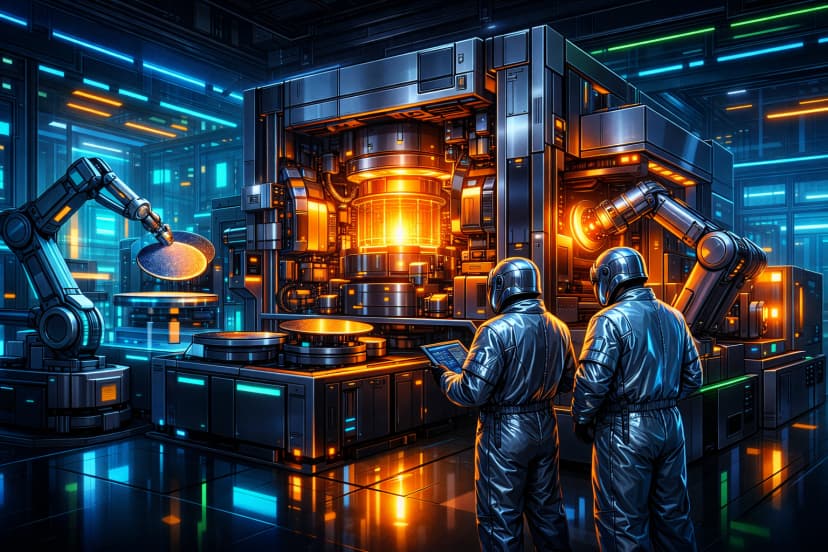
That possibility matters because it gives Intel's foundry strategy a practical customer angle. A facility designed to support Intel's manufacturing ambitions could also attract outside production, improve asset utilization, and strengthen the case for U.S.-based chip capacity. It is still a report about potential talks, not a completed agreement. Even so, the headline connects directly to the turnaround story that has pushed INTC sharply higher.
The move also received an analyst boost. Barclays upgraded Intel from Underperform to Overweight on September 16. Tigress Financial raised its target to $145 from $118 the prior day. Those actions add institutional validation to a stock already benefiting from renewed interest in artificial intelligence, domestic semiconductor manufacturing, and Intel's foundry plans.
Get AI research on any stock
Instant reports, daily intelligence, and an AI analyst in your pocket.
Intel Foundry Progress Gives the SK Hynix Story More Weight
Intel's foundry narrative has gained specific support from recent manufacturing milestones. In its Q2 2026 update, Intel said Intel 18A-P had entered risk production. The company also described improvements in performance, power, and thermal resistance across the 18A family.
A September 11 report added another data point. Intel Foundry had processed more than one million 300mm wafers on High-NA EUV scanners, according to TechRadar's report on Intel and ASML. That milestone does not prove commercial success, but it gives investors a measurable sign of activity in advanced manufacturing.
The business is therefore being valued on more than its traditional PC and server CPU base. Intel still serves client computing and data-center markets, yet investors are also assigning value to external foundry work, advanced packaging, and 18A execution. A potential SK Hynix arrangement could validate that broader model if the talks advance into a customer agreement.
Intel Corp. Financials and Valuation After the Move
Intel's earnings trend has improved in recent reported quarters. Q2 2026 EPS came in at $0.30, compared with a $0.10 estimate, a 200% surprise. The prior three earnings entries showed EPS of $0.29, $0.15, and $0.23. However, the headline EPS field is -$2.09, which means investors should avoid treating the company as a clean, steady-growth earnings story.
The balance sheet story also has two sides. Intel disclosed an equity offering of 210,526,315 shares at $95 each in August 2026, followed by an additional 31,578,947 shares through the underwriters' greenshoe option. The financing raised more than $20 billion for the turnaround and foundry buildout. It also increased the share count, creating dilution for existing holders.
At a $515.47 billion market cap, INTC now carries a much larger valuation than its distressed past implied. The analyst consensus target is $110.97, with a median target of $110. The $145 Tigress target is more aggressive, while the published target range spans $60 to $200. Because EPS is negative in the headline data, a standard price-to-earnings comparison offers little help. The valuation instead rests on foundry execution, AI relevance, and a successful manufacturing transition.
Intel retains major advantages. It has a large installed base in PCs and servers, a deep manufacturing footprint, and strategic importance to U.S. semiconductor policy. Its collaboration with NVIDIA also supports the idea that Intel remains relevant to AI infrastructure and custom x86 products.
The risks are just as concrete. AMD competes with Intel in client and server CPUs. NVIDIA dominates much of AI infrastructure. TSMC remains the leading benchmark in contract chip manufacturing. Intel also faces heavy capital needs and margin pressure while it upgrades its process technology.
For traders, the $99.60 intraday low is the clearest session reference after the SK Hynix headline. Holding above that level would preserve the day's momentum structure, while a break below it would weaken the immediate trading thesis. For longer-term investors, the more important tests are commercial progress at Intel Foundry, 18A production execution, and evidence that outside customers will use Intel's facilities.
Intel's stock now combines a real turnaround, a major capital raise, and a large amount of strategic optionality. That combination can produce powerful rallies, but it can also punish investors who mistake a promising fab headline for finished business results.
The September 16 move is best explained by the SK Hynix fab report and Barclays' upgrade, with recent 18A progress strengthening the narrative. INTC has a credible path to further gains if foundry execution becomes repeatable, but the negative headline EPS and capital intensity make disciplined position sizing essential.
INTC is rising after a report that SK Hynix may explore using an Intel U.S. fab for memory production. Barclays also upgraded Intel to Overweight, which added to the bullish momentum.
+Should I buy INTC stock now?
Intel has improving catalysts, but the stock still carries meaningful execution risk, capital intensity, and dilution concerns. It may suit investors who can tolerate volatility and are comfortable betting on the foundry turnaround.
+What is the main catalyst behind Intel's rally?
The main catalyst is the SK Hynix report about potential use of Intel's Ohio facility for memory production. That headline strengthens the case for Intel's foundry strategy and outside customer demand.
+Is Intel's move based on fundamentals or just news flow?
It's driven by both news flow and improving fundamentals. The SK Hynix report and analyst upgrades sparked the move, while recent 18A progress and better-than-expected quarterly EPS support the longer-term turnaround narrative.
▌The Daily Briefing · Free
A new stock idea, every evening.
One stock worth watching each weekday, plus the analysis behind it. Free, in your inbox.
▌The Full Report
Want the full picture on INTC?
The analyst-grade research report — charts, grades, valuation, and price targets — in 10 minutes.