Archer Aviation (ACHR): Certification Progress vs. Cash Burn
Archer Aviation has made real FAA certification progress and holds $1.8 billion of liquidity, but revenue is still minimal and losses remain heavy. The stock looks like a speculative Hold as commercialization and recurring revenue remain ahead of the curve.
Archer Aviation (ACHR) is a high-risk, high-upside aerospace story earning an overall grade of C+ and a Hold. Our fair value is $7, reflecting real certification progress and $1.8 billion of liquidity, but also minimal revenue, heavy losses, and cash burn that still outweigh near-term commercialization.
Thesis
Investment thesis: Archer Aviation (ACHR) is a high-upside, high-risk aerospace program with credible certification progress, $1.8 billion of liquidity, and three potential growth engines: commercial air taxis, defense aircraft, and aviation software. The investment case rests on Archer converting those assets into certified aircraft and recurring revenue. That conversion has not happened yet. Q1 2026 revenue was only $1.6 million against a $217.7 million net loss, while free cash flow was negative $181.7 million.
The positive case has hard milestones behind it. Archer's Means of Compliance for Midnight was fully accepted by the FAA in January 2026, the company said it became the first eVTOL developer to close Phase 3 of the four-phase type-certification process in April 2026, and two Midnight aircraft were flying while an initial fleet of 8 to 10 aircraft was being assembled. Archer also took control of Hawthorne Airport in Los Angeles and entered a partnership with Anduril to develop a hybrid autonomous VTOL aircraft.
The risk case is equally concrete. Archer's 2025 operating loss was $729.3 million, Q1 2026 operating expenses reached $256.2 million, and management guided to a Q2 adjusted EBITDA loss of $170 million to $200 million. Analyst estimates show revenue rising from $85.9 million in 2027 to $2.3 billion in 2030, but earnings remain negative through 2029. For a moderate-risk investor with a medium-term horizon, ACHR fits a small speculative position rather than a core holding.
That liquidity gives Archer time to execute, but time is not the same as proof. At $6.30, the stock already discounts meaningful progress toward certification and commercialization. The balance sheet supports a Hold view, while the valuation and cash burn prevent a Buy rating for a moderate-risk portfolio.
Company Overview
Archer Aviation Inc. (ACHR) is a San Jose, California-based aerospace and defense company listed on the NYSE. It designs electric vertical takeoff and landing aircraft, related powertrain and flight-control technologies, and aviation software for commercial and defense applications. The company had 1,160 full-time employees and 500 contingent workers at December 31, 2025.
▌Common Questions
Frequently asked questions
+Is ACHR stock a buy right now?
ACHR is a Hold, not a Buy, because the company has made meaningful certification progress but has not yet converted that progress into meaningful revenue. The report points to $1.8 billion of liquidity and a path to commercialization, but also to a $217.7 million Q1 2026 net loss and negative free cash flow of $181.7 million.
+What is ACHR's fair value?
Archer Aviation's fair value is $7. We arrive at that by weighing the company’s certification milestones, $1.8 billion liquidity cushion, and multi-engine growth optionality against ongoing losses, negative cash flow, and the fact that earnings are still projected to remain negative through 2029.
+
▌The Daily Briefing · Free
A new stock idea, every evening.
One stock worth watching each weekday, plus the analysis behind it. Free, in your inbox.
The company's core commercial aircraft is Midnight, a piloted eVTOL designed for urban air taxi operations. Archer is also developing a hybrid-electric autonomous VTOL platform with Anduril and artificial-intelligence tools for aviation and air traffic control. The business therefore combines a regulated aircraft program, an emerging defense platform, and a software initiative. Each has a different customer, approval path, and revenue timetable.
Archer's immediate commercial geography includes the United States and the United Arab Emirates. The company was selected as a partner in three winning eVTOL Integration Pilot Program applications across eight states and is preparing operations in cities that include Florida, Texas, and New York. In the UAE, the General Civil Aviation Authority moved Midnight into a Restricted Type Certification pathway, which Archer describes as a route toward limited early commercial operations.
Business Segment Deep Dive
Commercial aviation is Archer's primary long-term opportunity. The planned model includes aircraft sales, related technologies and services, and direct-to-consumer air taxi operations in selected metropolitan areas. Midnight is designed for short urban trips of around 20 miles, while management has described the broader mission as rapid back-to-back flights of 20 to 50 miles.
Defense is the second platform. Archer and Anduril are developing a clean-sheet hybrid aircraft rather than simply modifying Midnight for military use. Management said the defense vehicle has different payload, speed, range, and cost targets from the passenger aircraft. The 2025 10-K also identifies cargo and medical evacuation as potential commercial uses for the dual-use platform.
The third line is aviation software and autonomy. Archer has worked with Palantir, NVIDIA, and Starlink on airspace, onboard computing, and connectivity applications. The company has also introduced Zee, an aviation-focused foundation model trained on operational data from a network of more than 6,000 ADS-B receivers. These programs provide strategic optionality, but Q1 revenue was driven by expanded Hawthorne Airport operations rather than aircraft or software sales.
The flywheel concept is plausible because propulsion, manufacturing, autonomy, and flight-test data can serve more than one platform. It is also expensive. Q1 research and development spending was $171.7 million, and management said increased spending was directed toward Midnight, the defense aircraft, and software.
Get AI research on any stock
Instant reports, daily intelligence, and an AI analyst in your pocket.
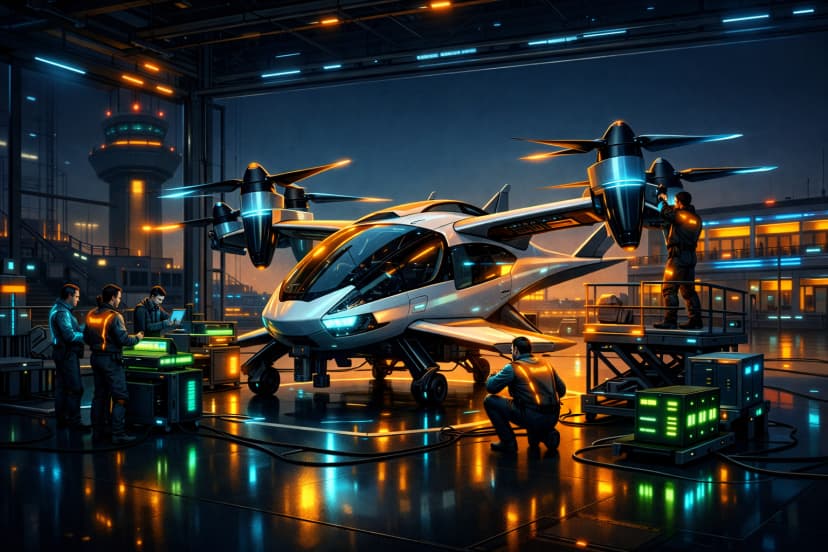
Midnight uses a 12-tilt-6 distributed electric propulsion architecture and is designed to carry four passengers plus a pilot. The aircraft uses redundant electric motors and a simpler propulsion layout than a traditional helicopter. Archer has optimized the design for short, frequent trips, low noise, and limited charging time between flights.
The product strategy is deliberately narrow. Rather than designing a general-purpose aircraft, Archer chose a partial-tilt configuration for urban air taxi operations and FAA certification. That focus can reduce design complexity, but it also ties Midnight's economics to short-distance passenger demand, vertiport access, pilot availability, and successful integration into local airspace.
Flight testing is moving from concept toward operational proof. Archer reported two aircraft flying in Q1 2026, with multiple aircraft flying multiple times per day during more complex piloted test points. The initial fleet of 8 to 10 aircraft is being allocated across certification, the eVTOL Integration Pilot Program, the Launch Edition program, and production preparation.
The principal product risk is not the passenger cabin. It is the full system around the aircraft. Midnight must complete the FAA implementation phase, obtain production certification, receive airworthiness certificates, and operate under the required commercial approvals. Archer's 10-K said it had received approximately 15% of the compliance verification documents for the final implementation phase.
Innovation & Competitive Advantage
Archer's strongest measurable advantage is certification progress. The FAA published final airworthiness criteria for Midnight in May 2024, Archer finalized the G-1 Issue Paper in June 2024, and the FAA fully accepted the aircraft's Means of Compliance in January 2026. Those milestones reduce process risk compared with an aircraft still defining its regulatory basis.
The second advantage is platform reuse. Archer is developing electric propulsion, flight-control software, and composite manufacturing capabilities internally while using established aerospace suppliers for components that are less central to differentiation. The Anduril program gives those capabilities a second application in autonomous defense aircraft.
The third advantage is ecosystem positioning. Archer has partnerships with seven airlines across its businesses, an Anduril defense relationship, and technology relationships with Palantir, NVIDIA, Starlink, and BETA. It also controls an airport in Los Angeles. These relationships do not guarantee orders or certification, but they place Archer inside the infrastructure and operating network required for an air taxi business.
That statement captures the investment issue. The moat is still forming. Certification, manufacturing quality, operating reliability, and passenger adoption must all reinforce the initial design advantage before it becomes durable.
Operations & Supply Chain
Archer is using a two-stage manufacturing approach. A Silicon Valley golden manufacturing line is supporting early Midnight builds and allowing the company to refine processes. A high-volume facility in Georgia is intended to support a production capacity of up to 50 aircraft per year.
Management said the immediate manufacturing work involves tooling, equipment, and production processes that can scale after certification. The company is also working on a production certificate with the FAA. This sequencing is sensible for a new aircraft, but it leaves Archer exposed to the familiar aerospace problem of moving from a small test fleet to repeatable commercial output.
Archer's internal focus is concentrated on electric and hybrid propulsion, flight-control software, and composites. Its 10-K identifies aluminum and composites as key raw materials and says the company depends on U.S. and international suppliers for quality, performance, cost, and delivery. Supplier execution therefore matters almost as much as Archer's own engineering.
Hawthorne Airport adds an operating asset and a capital commitment. Archer paid $127.1 million for lease agreements, operating rights, and development rights related to the airport in December 2025. The transaction also included an option to acquire 75% of the fixed-base operator business for a $25.0 million exercise price. The airport can support Los Angeles operations, but it also broadens the company's execution responsibilities beyond aircraft development.
Market Analysis
Archer is targeting a small but strategically important part of a large aerospace and defense market. The U.S. aerospace and defense market was estimated at $463.1 billion in 2026 and is projected to reach $610.2 billion by 2031, representing a 5.7% compound annual growth rate. Archer's opportunity is narrower: urban air mobility, autonomous VTOL aircraft, aircraft systems, and aviation software.
The commercial use case is built around time savings in congested metropolitan areas. Archer's 10-K identifies automobiles, ride-sharing services, aircraft, and helicopter charters as competing alternatives. Midnight's proposed advantage is a combination of short trip duration, low noise, safety systems, and a passenger experience that can connect airports, business centers, and population hubs.
The defense market has a different buying process. Defense customers prioritize mission performance, cost, autonomy, payload, and speed of deployment. Archer's hybrid autonomous platform with Anduril is designed around that requirement, while its partnership with the Department of Defense began through the Air Force AFWERX program in 2021.
Infrastructure is becoming part of the market rather than a separate detail. Archer is working with BETA on charging infrastructure, with cities and airports on launch locations, and with partners on vertiports. The ACES consortium involving Archer, BETA, and Macquarie is aimed at interoperable charging across more than 250 aviation sites by 2030.
Like what you're reading?
Get full access to AI-powered research reports, market analysis, and portfolio tools.
Archer's commercial customers fall into three groups. Airlines can purchase aircraft or integrate air taxi flights into passenger itineraries. Governments and airport authorities can support routes, infrastructure, and regulatory programs. Individual passengers are the eventual users of the air taxi service.
The airline relationship is important because airlines already understand ticketing, safety procedures, airport operations, and passenger distribution. Archer says it works with seven airlines across its businesses. In the UAE, Abu Dhabi Aviation is part of the planned Launch Edition program, giving Archer a named operating partner for early commercial activity.
The defense customer base includes the U.S. government, allied governments, and prime or specialist contractors. Archer and Anduril are competing for U.S. and U.K. defense opportunities, while the company has described interest from multiple international governments. These customers typically require extensive testing, qualification, mission integration, and procurement approval before revenue becomes material.
Customer adoption will depend on more than aircraft availability. A four-passenger aircraft must offer reliable departure times, convenient locations, acceptable pricing, and a safety record that supports repeat use. Archer's Part 135, Part 141, and Part 145 certificates provide operating, pilot-training, and repair foundations, but the commercial network still has to prove its usefulness in practice.
Competitive Landscape
The named public eVTOL competitors include Joby Aviation (JOBY), BETA Technologies, Eve Holding (EVEX), and Vertical Aerospace (EVTL). Archer also competes with helicopter operators, rotorcraft manufacturers, ride-hailing services, automobiles, and premium ground transportation. The 10-K identifies long development cycles, rapid technological change, and intense competition as defining features of the industry.
Archer's competitive position is strongest where certification and launch infrastructure matter. Midnight's Means of Compliance was accepted in January 2026, Archer has access to three winning eIPP applications across eight states, and the company controls Hawthorne Airport. Those facts give Archer a practical route to operational learning rather than relying only on laboratory progress.
BETA adds competitive pressure in aircraft development and charging infrastructure, while Joby remains a major passenger eVTOL rival. Archer's Anduril partnership changes the competitive frame by adding defense autonomy to the commercial aircraft race. The benefit is a second demand channel. The cost is a broader program portfolio that requires more capital and management attention.
The decisive comparison will be execution. A technically attractive aircraft does not win without certification, production quality, charging access, airline distribution, and dependable operations. Archer has concrete progress in each category, but only certification progress has reached a clearly reported milestone at scale.
Macro & Geopolitical Landscape
Government policy is a direct demand driver for Archer. The White House, DOT, and FAA created the eVTOL Integration Pilot Program, and Archer was selected as a partner in three winning applications. Management said the program is intended to support flying in U.S. cities during 2026.
Airspace modernization is another policy factor. Management cited an administration target of more than $20 billion for air traffic control modernization and argued that existing infrastructure was not designed for the volume of traffic expected over the next decade. Archer's Palantir relationship and aviation software work are positioned around that constraint.
International support is broad but execution remains country-specific. Archer has identified the UAE, Saudi Arabia, South Korea, and Japan as markets where governments are building infrastructure or accelerating regulatory pathways. The UAE's Restricted Type Certification pathway is the most concrete international regulatory step in the supplied record.
Geopolitical conditions also support the defense option. The U.S. and allied governments are emphasizing autonomy, advanced materials, mission software, and faster capability deployment. Archer's planned hybrid aircraft with Anduril is aligned with that direction, but defense awards remain dependent on formal procurement decisions rather than market enthusiasm.
Balance Sheet Health
▌Premium Members Only
$1.8 billion of liquidity gives Archer time to execute, but the report still frames the balance sheet as support for a Hold rather than a Buy.
Unlock the full analysis
Premium members get the complete breakdown — pick rationale, financial metrics, and recent earnings detail.
Archer Aviation has moved beyond a pure concept. Midnight has reached important FAA milestones, two aircraft were flying in Q1 2026, the company controls an airport in Los Angeles, and the Anduril partnership adds a credible defense pathway. Those facts make ACHR more than a distant technology story.
The financial statements keep the enthusiasm in check. Revenue remains small, losses remain large, free cash flow is negative, and management expects another substantial adjusted EBITDA loss in Q2. The company has the liquidity to pursue its plan, but the stock still requires investors to pay for a future that depends on certification, production, infrastructure, customer adoption, and government awards.
At $6.30, the risk-reward profile is balanced rather than compelling for a moderate-risk investor. The $7.00 fair-value estimate supports a Hold recommendation. A materially lower entry price would better compensate for the long commercialization timeline, while a move toward $10.50 or higher would demand evidence that Archer is converting aircraft progress into durable revenue.
Why is Archer Aviation rated Hold?
Archer is rated Hold because the balance sheet is strong enough to fund execution, but the business still lacks proof of scalable commercialization. The report highlights a $729.3 million operating loss in 2025, Q1 2026 operating expenses of $256.2 million, and a Q2 adjusted EBITDA loss guide of $170 million to $200 million.
+What are the biggest risks for ACHR?
The biggest risks are certification timing, commercialization execution, and continued cash burn. Archer has real progress with FAA acceptance and Phase 3 completion, but it still depends on turning those milestones into aircraft deliveries, air taxi operations, and recurring revenue.
+When could Archer Aviation become profitable?
The report’s estimates do not show profitability in the near term, with earnings still negative through 2029. Revenue is expected to rise from $85.9 million in 2027 to $2.3 billion in 2030, but the path to positive earnings depends on scaling commercial operations and controlling spending.
▌For Active Investors
Want Reports Like This on Any Stock?
Get AI-powered research reports, daily market intelligence, and a personal analyst in your pocket.