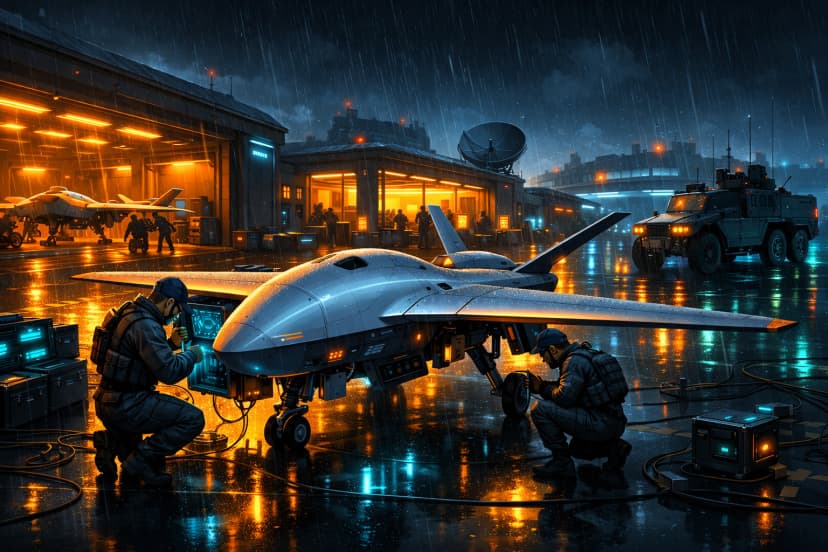
AEVEX is scaling fast on autonomous systems and mission software, but debt, negative free cash flow, and a rich valuation keep the stock in Hold territory.
AEVEX Corp. (AVEX) is not a clear buy right now, earning an overall grade of C+ and a Hold as the stock balances explosive revenue growth against cash-flow strain and a demanding valuation. Our fair value is $35.38, and investors should view AVEX as a Hold until execution proves the ramp in autonomous systems can translate into durable earnings and cash generation.
Thesis
AEVEX Corp. (AVEX) is a high-growth defense technology turnaround with strong exposure to autonomous unmanned systems, but its valuation and cash-flow profile demand disciplined execution. Q1 2026 revenue reached $216.7M, up 307% year over year, while net income improved to $20.9M from a $27.3M loss. The Q2 2026 investor presentation then reported revenue growth of 100% year over year, a 13.9% adjusted EBITDA margin, and raised full-year revenue guidance to $700M-$720M.
The operating story is compelling. Tactical Systems revenue rose 142% in Q2 2026 as the EUCOM Deep Strike program began ramping, and production volume increased 114% year over year. The financial story is less complete: 2025 operating cash flow was negative $97.6M, free cash flow was negative $106.1M, and the latest quarterly balance sheet showed debt of $261.4M and cash of $27.4M.
For a moderate-risk investor with a medium-term horizon, AVEX fits better as a Hold than as an aggressive purchase. The company has credible demand exposure and a large pipeline, yet customer concentration, program timing, debt movement, and a trailing P/E of 55.4x leave little room for operational disappointment.
Company Overview
Founded in 2020 and based in Solana Beach, California, AEVEX operates as a defense technology contractor focused on autonomous systems, mission software, intelligence, surveillance and reconnaissance, counter-unmanned aerial systems, and specialized aircraft work. The company had approximately 650 employees and listed on the NYSE on April 17, 2026.
AEVEX reports through two operating segments. Tactical Systems designs and manufactures modular, autonomous, and attritable unmanned systems, including unmanned aerial systems and unmanned surface vehicles. Global Solutions provides airborne ISR, counter-UAS capabilities, additive manufacturing, and aircraft engineering, modification, and testing.
▌Common Questions
Frequently asked questions
+Is AVEX stock a buy right now?
AVEX is a Hold right now, not a Buy. The company is growing rapidly, but negative free cash flow, $261.4M of debt, and a 55.4x trailing P/E make the risk/reward less compelling.
+What is AVEX's fair value?
AEVEX's fair value is $35.38. We arrive at that view by weighing the company’s strong revenue ramp and raised 2026 guidance against its negative cash flow, elevated leverage, and valuation that already prices in a lot of execution.
+Why is AVEX only rated Hold despite huge growth?
Because the growth is real, but it is still concentrated in Tactical Systems and tied to program timing like EUCOM Deep Strike. The report also highlights negative operating cash flow of $97.6M in 2025, free cash flow of negative $106.1M, and a balance sheet that needs disciplined execution.
▌The Daily Briefing · Free
A new stock idea, every evening.
One stock worth watching each weekday, plus the analysis behind it. Free, in your inbox.
The company's product mix puts it closer to specialized defense technology companies than to broad-based primes such as Lockheed Martin (LMT) or Northrop Grumman (NOC). That focus gives AVEX a direct connection to autonomy and low-cost systems, while also exposing it to the sharp swings that accompany a small number of large defense programs.
Business Segment Deep Dive
Tactical Systems is the economic engine. It represented approximately 88.0% of Q1 2026 revenue, or $190.8M, and revenue increased 547.8% year over year. The Q1 earnings release attributed the increase primarily to UAS products, including $161.0M of higher Tactical Systems revenue.
The Q2 2026 presentation showed the next stage of that ramp. Tactical Systems revenue increased 142% year over year, and segment adjusted EBITDA margin expanded by 1,289 basis points. The EUCOM Deep Strike program began ramping during the quarter, making program timing an important driver of both growth and margin.
Global Solutions accounted for approximately 12.0% of Q1 revenue. Its Q2 revenue declined 5% year over year because the prior-year period included an aircraft sale, while its adjusted EBITDA margin improved from 7.4% to 14.2%. The segment provides diversification through ISR, counter-UAS, aircraft modification, and mission-support work, but recent growth has clearly been concentrated in Tactical Systems.
Get AI research on any stock
Instant reports, daily intelligence, and an AI analyst in your pocket.
The product family at the center of AVEX's current growth is its UAS and launched-effects portfolio. The Q2 presentation identified Atlas and Disruptor in short- and long-range launched effects, while Onyx, Raker, Disruptor, and ForgeX were listed among one-way attack products.
Raker, Disruptor, and ForgeX also appeared in the long-range precision-strike portfolio. The company positioned Disruptor and Raker for Group III one-way attack systems in the CENTCOM area of responsibility. These product references matter because they show a portfolio spanning multiple ranges, missions, and operating environments rather than a single airframe.
The commercial evidence is the EUCOM Deep Strike ramp and the 114% year-over-year increase in production volume. Those facts support the view that AVEX is moving from product development toward scaled delivery. The negative $11.6M of quarterly free cash flow in Q1 2026 shows that scaling also consumes working capital before it fully becomes cash.
Innovation & Competitive Advantage
AEVEX combines engineering, rapid prototyping, and manufacturing within an integrated operating model. Its materials emphasize autonomous systems that can operate in contested and GPS-denied environments, along with AI-enabled mission software and mission-specific integration.
The company also describes a track record of winning and executing Programs of Record. In defense, that type of qualification and delivery history can strengthen customer relationships because a system that has already moved through testing and deployment carries more practical value than an unfielded concept.
The advantage is therefore operational as much as technological. AEVEX offers hardware, software, ISR, and specialized engineering under one platform. That breadth can reduce integration friction for customers, while the Tampa facility expansion and supply-chain investments are designed to support higher production volumes. Larger competitors still bring deeper capital and broader procurement relationships, so the advantage is useful but not impregnable.
Operations & Supply Chain
The Q2 2026 presentation reported production volume growth of 114% year over year, expansion and consolidation of Tampa production facilities, and additional investment in supply-chain capability. The company also cited better contract terms with suppliers and customers, operating efficiencies, pricing discipline, and a disciplined capital-expenditure approach.
The margin data confirms that operations improved as volume rose. Company-wide adjusted EBITDA margin increased to 13.9% from 3.6% in the prior-year comparison, a 1,036-basis-point expansion. Tactical Systems produced the larger improvement, while Global Solutions benefited from the absence of substantial costs tied to the prior-year aircraft sale.
Cash conversion remains the weak link. Annual operating cash flow moved from positive $64.9M in 2024 to negative $97.6M in 2025. Q1 2026 operating cash flow was negative $10.4M, and capital expenditures were $1.3M. The combination of higher production, backlog conversion, and negative cash flow makes working-capital control central to the investment case.
Market Analysis
AEVEX operates in defense categories with measurable expansion signals. The company's S-1 framed its core markets, including UAS, launched effects, loitering munitions, one-way attack systems, and USVs, at approximately $11.0B annually in the U.S. and $26.0B globally by 2030. Its adjacent markets were estimated at $19.0B in the U.S. and $23.0B globally by 2030.
That produces a combined annual opportunity of approximately $31.0B in the U.S. and $49.0B globally by 2030. The Q2 presentation also showed pipeline growth from $8.1B in the fourth quarter of 2025 to $10.5B in the second quarter of 2026, while lifetime book-to-bill stood at 1.08x.
Broader market data reinforces the setting. Mordor Intelligence estimates the U.S. aerospace and defense market at $463.1B in 2026, rising to $610.2B by 2031 at a 5.7% CAGR. MarketsandMarkets estimates integrated air and missile defense growth at a 12.5% CAGR from 2025 through 2030, while defense cybersecurity is projected at an 8.3% CAGR. These figures support demand for AVEX's categories, but market growth does not guarantee a particular contract win.
Like what you're reading?
Get full access to AI-powered research reports, market analysis, and portfolio tools.
AEVEX serves government and national-security customers that require autonomous systems, precision strike, ISR, counter-UAS, and specialized mission support. The customer base is heavily concentrated: approximately 73.9% of funded backlog at March 31, 2026 was tied to the U.S. Government.
Funded backlog was $356.6M at March 31, 2026, and management expected approximately 93.0% of that amount to convert into revenue during the remainder of 2026. The Q2 presentation separately reported beginning backlog of $503M in both the first and second quarters, implied book-ship of $207M in Q2 versus $107M in Q1, and additional awards already noted for the third quarter.
The customer profile offers visibility but also concentration risk. Government procurement can support large orders when priorities align with autonomy and precision strike, yet continuing resolutions, funding changes, contract amendments, and customer termination rights can shift the timing of revenue. AEVEX's Q1 guidance specifically assumed an open U.S. government and no prolonged continuing resolutions.
Competitive Landscape
AEVEX competes with specialized autonomy and UAS companies such as AeroVironment (AVAV), Elbit Systems (ESLT), Textron (TXT), and private companies Anduril and Shield AI. It also faces larger defense primes including Northrop Grumman (NOC), Lockheed Martin (LMT), RTX (RTX), and L3Harris Technologies (LHX).
For mission solutions and engineering services, the competitive field includes CACI International (CACI), Science Applications International (SAIC), Amentum, Booz Allen Hamilton (BAH), MTSI, Riverside Research, and SMX. These companies compete more directly on integration, engineering depth, and government program execution than on unmanned hardware alone.
AVEX's advantage is specialization. Its portfolio combines autonomous platforms, launched effects, ISR, mission software, and aircraft modification. Its disadvantage is scale: the large primes have broader customer relationships and production resources, while private specialists such as Anduril and Shield AI bring substantial focus to autonomy and software. The 2026 production ramp will determine whether AEVEX can turn its focused portfolio into durable share gains.
Macro & Geopolitical Landscape
The macro backdrop favors defense modernization, autonomy, and resilient communications. Gartner research identifies geopolitical conflict, global power competition, and modernization urgency as forces pushing defense organizations toward more agile, data-driven operations. AEVEX's focus on contested environments and autonomous systems aligns directly with those priorities.
Technology adoption also supports the category. Deloitte reported that 81% of aerospace and defense respondents already use or plan to use AI and machine learning. Gartner highlighted physical AI, decision intelligence, autonomous cyber defense, and battlefield awareness as important defense themes, while Mordor estimates defense big-data analytics growth at a 17.0% CAGR through 2031.
The same government link creates the principal macro risk. AEVEX's Q1 2026 guidance depended on government funding continuity, and 73.9% of funded backlog was connected to the U.S. Government. Supply-chain pressure, inflation, cybersecurity events, and changes in procurement rules can also affect a small contractor more sharply than a large diversified prime.
Balance Sheet Health
▌Premium Members Only
Debt stood at $261.4M against just $27.4M of cash in the latest quarter, leaving AVEX with limited cushion as it funds growth.
Unlock the full analysis
Premium members get the complete breakdown — pick rationale, financial metrics, and recent earnings detail.
AEVEX has moved from a 2025 earnings setback into a powerful 2026 operating recovery. Revenue reached $216.7M in Q1, Tactical Systems drove the expansion, Q2 adjusted EBITDA margin reached 13.9%, and full-year guidance increased to $700M-$720M of revenue. Those are substantial improvements, not merely a better corporate slogan.
The investment decision still turns on conversion. AVEX must translate its $10.5B pipeline, $356.6M funded backlog, and expanding production capacity into durable free cash flow while managing government concentration and higher quarterly debt. Until that conversion is visible in the cash-flow statement, the $35.38 Hold level is the most balanced anchor for a medium-term, moderate-risk investor.
+What are the biggest risks for AVEX stock?
The biggest risks are customer concentration, program timing, debt, and cash burn. AVEX has strong demand exposure, but the report notes that a small number of large defense programs can swing results materially.
+What is driving AVEX's growth?
Tactical Systems is the main driver, with Q1 revenue up 547.8% year over year and Q2 revenue up 142% year over year. The ramp in UAS products and the EUCOM Deep Strike program are the clearest catalysts behind the surge.
▌For Active Investors
Want Reports Like This on Any Stock?
Get AI-powered research reports, daily market intelligence, and a personal analyst in your pocket.