Casey's General Stores (CASY): Food-Led Growth at a Premium
Casey's posted strong fiscal 2026 growth, led by prepared food, fuel, and store expansion, but the shares already reflect much of the upside. The report lands on a Hold with a fair value estimate of $850.
Casey's General Stores (CASY) looks like a solid business but only a Hold right now, earning an overall grade of B. Fiscal 2026 revenue rose 14.5% to $17.6B and diluted EPS climbed 31% to $19.16, yet the shares already trade at 39.5x trailing earnings and 36.4x forward earnings. Our fair value estimate is $850.
Thesis
Investment thesis: Casey's General Stores (CASY) is a high-quality, food-led convenience retailer with strong operating momentum, a dense small-town footprint, and a proven record of integrating acquisitions. Fiscal 2026 revenue rose 14.5% to $17.6B, diluted EPS increased 31% to $19.16, and free cash flow reached $721.6M. The business deserves a premium for its prepared-food platform and execution, but a 39.5x trailing P/E, 36.4x forward P/E, and 3.3 PEG ratio leave limited room for weaker fuel margins or a slower consumer.
The central attraction is the combination of fuel traffic and high-margin inside sales. Fiscal 2026 prepared food and dispensed beverage same-store sales increased 5.2%, inside margin expanded to 42.2%, and fuel gross profit grew 21%. Casey's also opened or acquired 80 stores, converted 50 CEFCO locations, and exceeded its prior three-year goal by adding more than 500 units.
The medium-term outlook remains constructive. Management's fiscal 2027 plan calls for 2% to 5% inside same-store sales growth, EBITDA growth of 8% to 10%, at least 120 store openings, and approximately $800M of capital spending. Those figures support continued earnings growth, but the stock's valuation already prices in a meaningful portion of that progress. The result is a Hold for moderate-risk investors, with our fair value estimate of $850.
Company Overview
Founded in 1959 and headquartered in Ankeny, Iowa, Casey's operates convenience stores across 19 states. The company combines gasoline, grocery and general merchandise, prepared food, beverages, lottery, financial services, car washes, and other convenience offerings. Casey's ended fiscal 2026 with 2,944 stores and describes itself as the third-largest convenience retailer in the United States.
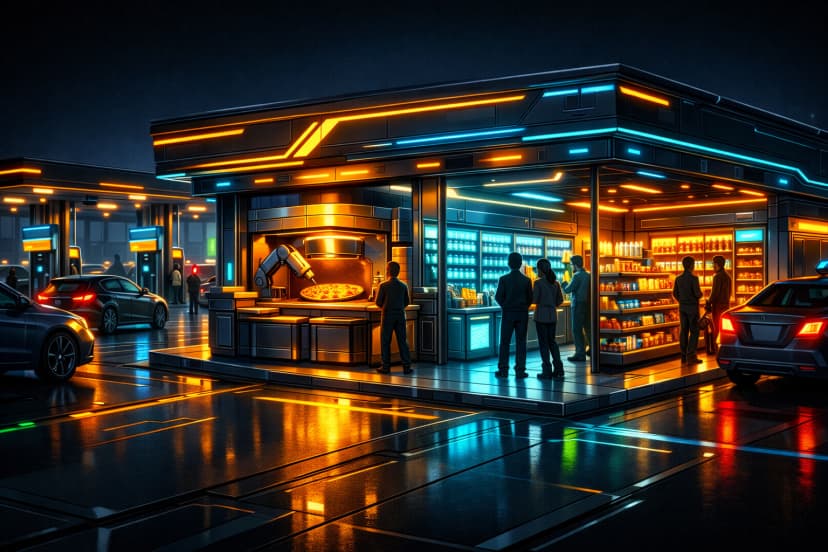
The company has built a distinct food identity inside a fuel-led retail format. Management identifies Casey's as the fifth-largest pizza chain in the U.S., and pizza is available in almost all stores. That positioning creates a broader customer proposition than a fuel-only operator: gasoline creates traffic, while pizza, beverages, snacks, and other inside products increase basket size and gross profit.
▌Common Questions
Frequently asked questions
+Is CASY stock a buy right now?
Casey's General Stores (CASY) is not a Buy right now; it is rated Hold. The business is executing well, but the stock's premium valuation already prices in much of the growth from prepared food, fuel, and store expansion.
+What is CASY's fair value?
Casey's fair value is $850. That view reflects the report's 39.5x trailing P/E, 36.4x forward P/E, and 3.3 PEG ratio, balanced against strong fiscal 2026 growth, 42.2% inside margin, and management's fiscal 2027 plan for 8% to 10% EBITDA growth.
+Why is Casey's General Stores rated Hold?
▌The Daily Briefing · Free
A new stock idea, every evening.
One stock worth watching each weekday, plus the analysis behind it. Free, in your inbox.
Scale is becoming more important in the model. Casey's operates three company distribution centers and says its network delivers about 70% of in-store products and 60% of fuel. Its Rewards platform has about 11 million members, and the company joined the S&P 500 in April 2026. These facts reinforce Casey's position as a scaled regional operator rather than a collection of isolated stores.
Business Segment Deep Dive
Casey's economics are built around two operating engines: fuel and inside-store sales. Fuel remains a major revenue and traffic driver, but the inside business carries the stronger margin profile. Fiscal 2026 total inside sales increased 10.2%, while inside same-store sales rose 4.2%. Inside margin expanded 70 basis points to 42.2%.
Prepared food and dispensed beverages were the strongest inside category. Fiscal 2026 sales increased 10.2% and same-store sales rose 5.2%. In the fourth quarter, prepared food and dispensed beverage sales increased 9.2% to $428M, same-store sales rose 6.6%, and average margin reached 59.5%, up 170 basis points year over year.
Grocery and general merchandise provide a larger sales base with a lower, but expanding, margin. Fourth-quarter sales increased 6.7% to $1.09B, same-store sales rose 5.1%, and average margin reached 35.7%, up 90 basis points. Energy drinks, nicotine alternatives, and liquor supported the category mix.
Fuel performance was unusually strong in fiscal 2026. Total gallons sold rose 10%, fuel gross profit increased 21%, and average fuel margin reached $0.426 per gallon. In the fourth quarter, same-store gallons increased 1.5% and fuel margin reached $0.469 per gallon. The fiscal 2027 outlook is more measured, calling for same-store gallons between negative 1% and positive 1%.
Get AI research on any stock
Instant reports, daily intelligence, and an AI analyst in your pocket.
Casey's flagship product is its pizza platform, particularly whole pizzas. Management reported that whole pizzas helped drive fiscal 2026 results, and fiscal 2027 materials highlighted strong guest response to whole pies. The product combines convenience, value, and a clear brand identity in a category where Casey's has national scale.
Breakfast pizza extends the product beyond the traditional lunch and dinner occasions. Casey's reported selling more than 2 million whole pie breakfast pizzas before noon in the prior year and more than 32 million breakfast pizza slices before noon. Those figures show how the product can support daypart expansion rather than simply compete for an existing dinner order.
Wings are the most important recent extension. By the end of fiscal 2026, sauced wings were available at nearly 850 stores. Management reported that guests ordering wings independently increased prepared-food order frequency by 30%, while whole-pizza volume at wing locations remained up by high-single digits. That combination points to incremental occasions rather than simple pizza substitution.
The product economics are attractive but not risk-free. Prepared food margin benefited from improved waste, a lower LIFO charge, and cheese costs of $2.00 per pound, down $0.06 per pound year over year in the fourth quarter. Waste reduction is a company-controlled improvement, while cheese and other ingredients remain exposed to commodity cycles.
Innovation & Competitive Advantage
Casey's innovation strategy is practical rather than theatrical. During fiscal 2026, the company expanded its specialty pizza menu, launched Thin Crust Pizza, tested limited-time offers, introduced the FROSTBITE frozen carbonated beverage platform, expanded Darn Good Coffee, and rolled out sauced wings and crispy fries.
Exclusive or limited distribution products also support traffic. A Monster Red, White and Blue Razz flavor sold almost exclusively at Casey's from late January to early May and ranked among the top energy products during the quarter. The arrangement also supported charitable giving, tying a product launch to Casey's community positioning.
The strongest structural advantage sits in category management. Casey's expanded space for nicotine alternatives while reducing cigarette space, and management reported that the mix shift is margin accretive. Energy drinks are another higher-margin part of the nonalcoholic beverage category. More than 1,500 liquor licenses also give Casey's a broader assortment in a category management described as margin accretive relative to beer.
The moat is therefore a system, not a single product. A dense footprint, company-operated distribution, prepared food, loyalty data, and fuel pricing reinforce one another. Management described this as a flywheel in which the inside offering and competitive fuel prices support both inside and fuel comps.
Operations & Supply Chain
Casey's distribution network is a meaningful operating asset. Three company distribution centers serve about 70% of in-store products and 60% of fuel, giving the company control over replenishment and product availability across a geographically dispersed footprint. That structure is particularly useful in small-town markets where scale can be harder for local operators to achieve.
Execution improved during the prior three-year plan. Same-store labor hours fell approximately 5% over three years, while turnover improved by more than 70 percentage points. In fiscal 2026, same-store operating expenses excluding credit card fees increased only 3.7%, and same-store labor hours declined 0.2%.
Growth now raises the operational bar. Casey's expects at least 120 fiscal 2027 store openings through an even mix of acquisitions and new construction. Capital spending is expected to reach approximately $800M, including the conversion of most CEFCO stores. The company has already demonstrated conversion capability by remodeling 50 CEFCO locations, but integrating acquisitions while maintaining food quality and labor efficiency will remain a central execution task.
Capital allocation supports expansion without abandoning shareholders. The board raised the quarterly dividend to $0.65 per share, marking the 27th consecutive annual increase, and authorized a share repurchase program of up to $1B. Management expects approximately $200M of repurchases in fiscal 2027.
Market Analysis
The convenience market is moving toward prepared food, loyalty, and scale, all areas that fit Casey's strategy. NACS reported that foodservice represented 27.7% of in-store sales and 38.6% of in-store gross margin dollars in 2024. Prepared food represented 73.9% of foodservice sales in 2025, up from 66.4% in 2021.
The broader U.S. convenience-store industry generated $341.2B of in-store sales in 2025, according to NACS. Casey's does not need to dominate the entire market to grow. Its more relevant opportunity is the higher-margin prepared food, beverage, and convenience occasion within its existing footprint.
Casey's footprint gives it a specific market position. About two-thirds of its stores are in towns with populations of 20,000 or fewer, and roughly half of its stores are concentrated in Iowa, Missouri, and Illinois. This density supports local brand recognition and distribution efficiency, while the small-town focus reduces direct exposure to the most crowded urban retail corridors.
The tradeoff is that food retail remains a moderate-growth industry. Casey's needs to create growth through same-store food sales, new stores, acquisitions, and mix improvement rather than rely on a rapidly expanding end market. Fiscal 2027 guidance of 2% to 5% inside same-store sales captures that reality.
Like what you're reading?
Get full access to AI-powered research reports, market analysis, and portfolio tools.
Casey's serves customers who value speed, proximity, and a broad one-stop purchase. Fuel draws visits, while pizza, breakfast items, beverages, snacks, tobacco and nicotine products, alcohol, and general merchandise create multiple reasons to enter the store. The model is especially well suited to small-town and rural trade areas where a convenience store can serve as both a fuel stop and a quick meal destination.
Management reported growth across low-, middle-, and higher-income customer groups, with somewhat slower growth among customers earning below $50,000. Customers earning between $50,000 and $100,000 and those earning more than $100,000 represented three-fourths of the guest base and were spending comparably to prior periods.
The fuel customer is becoming more value conscious. In the fourth quarter, premium fuel sales softened slightly, ethanol-blended fuel gained share, gallons per transaction declined slightly, and fuel transaction counts increased. Casey's Rewards gallons redeemed rose 23%, showing that loyalty discounts are becoming a meaningful part of the value proposition.
The customer relationship is also becoming more measurable. Casey's Rewards has about 11 million members, giving the company a large base for personalized offers and repeat visits. The combination of loyalty data and prepared food frequency gives Casey's a stronger customer engine than a retailer dependent only on fuel price.
Competitive Landscape
Casey's competes with convenience chains, fuel marketers, supermarkets, drug stores, discount retailers, club stores, mass merchants, and fast-food outlets. Named regional competitors include QuikTrip, Kwik Trip, and Kum & Go. National convenience competitors include 7-Eleven and Circle K.
Casey's differentiates itself from fuel-led operators through prepared food, especially pizza. Against supermarkets and mass merchants, it offers speed and proximity rather than assortment breadth. Against quick-service restaurants, it adds gasoline, beverages, and convenience merchandise to the food purchase.
The competitive edge is strongest in small and mid-sized markets. A dense regional footprint supports brand awareness, while three distribution centers and company delivery capabilities improve product availability. The risk is that larger national chains can spend more on technology, pricing, and site development, while fast-food chains remain formidable competitors for prepared meals.
Casey's recent results show that its model is working against that competition. Fiscal 2026 inside same-store sales rose 4.2%, prepared food and dispensed beverage same-store sales rose 5.2%, and inside margin reached 42.2%. Those results do not eliminate competitive pressure, but they show a differentiated proposition with measurable customer response.
Macro & Geopolitical Landscape
Fuel prices create both earnings opportunity and risk. Management said the average retail fuel price was about $4.20 per gallon during the latest discussion and that demand destruction has historically become more visible near $5 per gallon. Higher prices can lift reported fuel revenue and, in volatile conditions, temporarily support margin, but sustained high prices can reduce gallons and alter customer mix.
The fiscal 2026 fuel outcome benefited from price volatility associated with conflict in oil-producing regions. Management said uneven price movement allowed the company to hold retail prices relatively steady at points while wholesale costs moved, widening margin temporarily. That is an operating observation, not a dependable long-term earnings engine.
Prepared food faces a different macro exposure. Cheese costs fell to $2.00 per pound in the fourth quarter and contributed approximately 15 basis points of margin benefit. Management described prepared food as more commodity oriented, meaning ingredient inflation can reverse part of the recent margin improvement.
Labor and payment costs also matter. Fiscal 2027 operating expenses are expected to rise 5% to 7%, while management cited wage rates and higher credit card fees as fourth-quarter expense factors. Geopolitical disruptions, weather, cyber events, transportation constraints, and supplier interruptions are additional risks to Casey's distribution network.
Balance Sheet Health
▌Premium Members Only
Free cash flow reached $721.6M in fiscal 2026, giving Casey's room to fund growth while keeping leverage and liquidity in good shape.
Unlock the full analysis
Premium members get the complete breakdown — pick rationale, financial metrics, and recent earnings detail.
Casey's is one of the stronger operators in convenience retail. Fiscal 2026 delivered record diluted EPS of $19.16, $714.4M of net income, $721.6M of free cash flow, and a 12.7% return on invested capital. The combination of pizza, prepared food, fuel, loyalty, distribution, and small-town density gives CASY a durable competitive position.
The next phase is more demanding. Casey's must integrate acquisitions, convert CEFCO stores, open at least 120 units, protect inside margin above 42%, and manage approximately $800M of capital spending. Management's 8% to 10% EBITDA growth outlook provides a credible foundation, but the current valuation already rewards a large portion of that execution.
For a medium-term, moderate-risk portfolio, Hold is the disciplined conclusion. Casey's is a business to respect and accumulate at a better entry point, rather than chase after a year in which both earnings and fuel profitability reached unusually strong levels.
Casey's is rated Hold because the operating story is strong but the valuation is demanding. Fiscal 2026 revenue rose 14.5% and EPS rose 31%, yet the shares already trade at 39.5x trailing earnings, leaving limited upside unless execution stays exceptional.
+What are the main growth drivers for CASY?
The main growth drivers are prepared food, fuel traffic, and store expansion. Prepared food and dispensed beverage same-store sales rose 5.2%, fuel gross profit grew 21%, and Casey's added or opened 80 stores while converting 50 CEFCO locations.
+What is the biggest risk for Casey's stock?
The biggest risk is that the premium multiple leaves little cushion if fuel margins soften or consumer demand slows. Management expects same-store gallons to range from down 1% to up 1% in fiscal 2027, so a weaker fuel backdrop could pressure results.
▌For Active Investors
Want Reports Like This on Any Stock?
Get AI-powered research reports, daily market intelligence, and a personal analyst in your pocket.