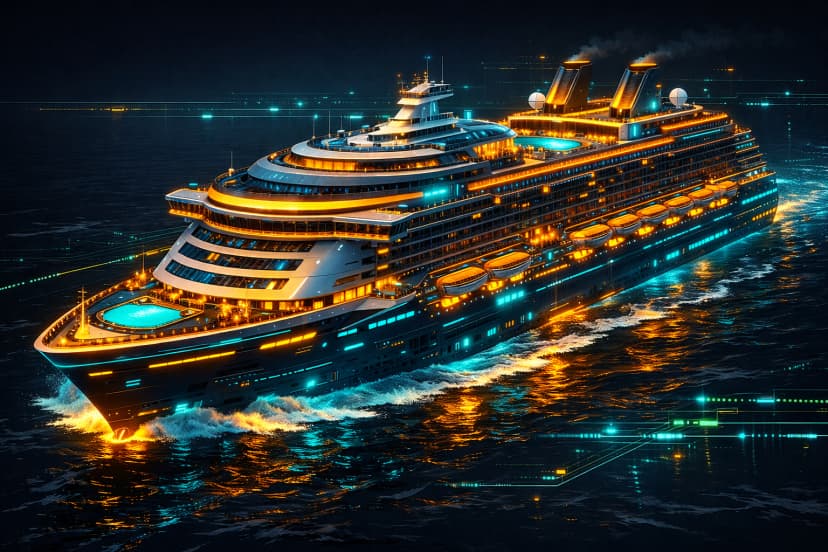
Royal Caribbean Cruises (RCL): Premium Pricing Drives Growth
Royal Caribbean is delivering record pricing, strong margin expansion, and double-digit revenue growth as its premium cruise platform keeps monetizing demand better than a typical cyclical operator.
Royal Caribbean Cruises Ltd (RCL) looks like a good investment right now, earning an overall grade of B+ and a Buy. The business is compounding through record pricing, premium brand mix, and strong margin expansion, and our fair value is $330.
Thesis
Royal Caribbean Cruises Ltd (RCL) stands out as one of the strongest operators in leisure travel because the numbers show a business that is growing, widening margins, and monetizing demand better than a typical cyclical operator. In 2025, revenue reached $17.93B, net income rose to $4.27B, operating margin hit 27.4%, and trailing EPS reached $16.39. In Q1 2026, the company followed that with $4.5B of revenue, $3.60 of adjusted EPS, 38.2% adjusted EBITDA margin, and 11% YoY revenue growth.
The core investment case is simple. RCL has built a premium vacation platform around scale, brand segmentation, private destinations, digital distribution, and repeat-customer economics. Management reported a record WAVE season, record pricing, over 2.5M vacations delivered in Q1 2026, and a booked position within historical ranges at record APDs. That is not the profile of a company relying on discounting to fill cabins.
The main reason to stay balanced rather than euphoric is leverage and exposure to external shocks. Total debt was $22.64B against $940M of cash in the debt snapshot, and management said fuel at current spot levels creates a $0.62 per share headwind for 2026. Mediterranean and West Coast of Mexico itineraries also saw temporary booking moderation tied to geopolitical disruption. Even so, management still guided to $17.10 to $17.50 in 2026 adjusted EPS and roughly double-digit revenue growth. That combination supports a constructive medium-term view.
Company Overview
Royal Caribbean Cruises Ltd (RCL) is a global cruise and vacation company headquartered in Miami. As of Dec. 31, 2025, it operated 69 ships across Royal Caribbean International, Celebrity Cruises, and Silversea, with a 50% joint venture interest in TUI Cruises. The company employed 107,950 people and served itineraries across more than 1,000 destinations on all seven continents.
The business is still overwhelmingly cruise-driven. In 2025, Cruise Itinerary revenue was $17.07B, or 95.2% of total revenue, while Other Products and Services contributed $864M, or 4.8%. That mix matters. It means the company remains tied to ship deployment, occupancy, pricing, and onboard spend, but it also shows a growing ancillary layer around destinations, digital monetization, and pre-cruise purchases.
▌Common Questions
Frequently asked questions
+Is RCL stock a buy right now?
Yes, RCL is a Buy right now. The company is posting record pricing, 11% Q1 2026 revenue growth, and a 38.2% adjusted EBITDA margin, which supports continued earnings power despite leverage.
+What is RCL's fair value?
Royal Caribbean Cruises Ltd's fair value is $330. We get there by weighing its premium pricing power, strong margin profile, and guided 2026 EPS of $17.10 to $17.50 against elevated debt of $22.64B and fuel/geopolitical risks that justify a more balanced multiple than the most bullish cases.
+What is driving Royal Caribbean's growth?
▌The Daily Briefing · Free
A new stock idea, every evening.
One stock worth watching each weekday, plus the analysis behind it. Free, in your inbox.
RCL has moved beyond the old image of a pure berth seller. The 10-K describes a broader vacation ecosystem that includes private destinations, beach clubs, loyalty programs, direct digital channels, and new formats such as Celebrity River Cruises. Management’s Perfecta framework targets 20% adjusted EPS CAGR from 2024 through 2027 and ROIC in the high teens by 2027. That is an aggressive target, but it is tied to a business already producing stronger margins and cash flow than it did before the pandemic.
Business Segment Deep Dive
RCL reports two revenue buckets: Cruise Itinerary and Other Products and Services. Cruise Itinerary generated $17.07B in 2025, up from $15.70B in 2024 and $13.23B in 2023. Other Products and Services generated $864M in 2025, up from $788M in 2024 and $668M in 2023. Both lines are growing, but the cruise engine still does the heavy lifting.
Within the operating portfolio, Royal Caribbean is the largest brand and the broadest in market reach, with 29 ships and about 111,000 berths as of Dec. 31, 2025. Celebrity Cruises adds 15 ships and about 38,900 berths in the premium segment. Silversea adds 12 ships and about 5,500 berths in luxury and expedition travel. The TUI Cruises joint venture broadens exposure to the German market with 13 ships across TUI Cruises and Hapag-Lloyd Cruises.
The strategic logic of this mix is strong. Royal Caribbean brings scale and family-oriented volume, Celebrity captures premium guests, and Silversea reaches the luxury traveler willing to pay for smaller ships and remote itineraries. That brand ladder gives RCL multiple ways to capture leisure spending while also creating trade-up opportunities inside its loyalty ecosystem.
Other Products and Services is still small, but it punches above its weight strategically. Management tied yield growth to private destinations including Royal Beach Club Paradise Island, Royal Beach Club Santorini, Royal Beach Club Cozumel, and Perfect Day Mexico. These assets improve itinerary control and create more opportunities to capture spend that would otherwise leak to third parties. In plain English, RCL is trying to own more of the vacation wallet, not just the cabin fare.
Get AI research on any stock
Instant reports, daily intelligence, and an AI analyst in your pocket.
The flagship product inside the portfolio is the Royal Caribbean brand, and within that brand the Icon class is the clearest expression of the company’s strategy. The 10-K lists Icon of the Seas, Star of the Seas, and the upcoming Legend of the Seas as major capacity and product pillars, each around 5,600 berths. Management also announced orders for Icon VI and Icon VII, with deliveries in 2029 and 2030.
Why does this matter for investors? Because the company repeatedly ties new hardware to premium pricing and return economics. Jason Liberty said Legend of the Seas is in a very strong book position with prices higher than those seen for Icon and Star. That is a direct sign that the newest ships are not just filling capacity, they are lifting price realization.
The product formula is clear: larger ships, differentiated attractions, exclusive destinations, and higher digital monetization before guests even board. More than half of onboard revenue is now booked before embarkation, according to management, and pre-cruise booking engines have over 70% penetration with more than five items purchased per booking. That turns the ship from a ticket product into a vacation bundle. It is a better business model because it raises visibility and deepens spend per guest.
Innovation & Competitive Advantage
RCL’s moat is not one thing. It is a layered system built on fleet scale, destination control, digital engagement, loyalty, and shipyard access. The company’s 10-K says its competitive edge comes from innovation, the quality and variety of ships, private destinations, itinerary breadth, and technology. The Q1 2026 call gave that statement some teeth.
Digital penetration of bookings has more than doubled since 2019, with most of that growth coming through the app. Monthly active users are 5x higher than 2019 levels, and app adoption is above 90%. More than half of onboard revenue is booked before the guest steps onboard, mostly through digital channels. That matters because direct digital engagement lowers friction, supports upselling, and gives the company more pricing and behavior data.
Loyalty is another real advantage. The company said its loyalty programs across brands have over 28M enrolled members worldwide, and management noted that about 40% of customers now come from the current customer base versus a historical one-third mix. Cross-brand bookings increased significantly after status match initiatives launched in 2023 and 2024. That is a useful sign that the portfolio is behaving more like an ecosystem than a collection of separate brands.
Shipyard access is the less glamorous moat, but it matters. The company confirmed orders for sixth and seventh Icon-class ships and said its framework with Meyer Turku secures shipbuilding capacity through 2036. In a capital-heavy industry where premium newbuild slots are limited, that is a strategic advantage. It is the kind of edge markets ignore until competitors cannot get the hardware they need.
Operations & Supply Chain
RCL’s operations are a global logistics machine. As of Dec. 31, 2025, the combined fleet across Global Brands and Partner Brands had 189,420 berths expected in 2026, with ships ranging from large Royal Caribbean vessels to smaller luxury and expedition ships under Silversea and Hapag-Lloyd. This spread gives the company deployment flexibility, but it also creates exposure to fuel, dry docks, port access, air travel disruptions, and regional instability.
The Q1 2026 call showed both the resilience and fragility of that system. Two TUI Cruise ships in the Middle East had to pause operations and were repositioned to the Mediterranean. Management also cited increased dry dock days, crew travel costs, airline capacity reductions, and flight disruptions as headwinds for Q2 and Q3. In the second quarter, those factors contribute almost 200 basis points of yield headwind and nearly 400 basis points of cost headwinds.
Fuel remains the most visible supply-side risk. Management expects fuel expense of about $1.349B in 2026 and said the company is 59% to 60% hedged for the remainder of the year. Even with hedging, current spot fuel prices create a $0.62 per share headwind for 2026. That is the kind of reminder this industry serves regularly: a great booking curve still burns fuel.
The good news is that cost discipline has been strong. Q1 2026 net cruise costs excluding fuel were better than expected, and full-year NCCx is expected to be approximately flat in constant currency, 50 basis points better than prior guidance. For a company adding capacity 6.7% in 2026, flat ex-fuel unit costs is a meaningful operating achievement.
Market Analysis
RCL operates inside a large travel market with room for continued share gains. Management pegs the leisure marketplace at $2.1T to $2.2T, while the 10-K says the global vacation industry is over $2T and that cruising still holds a small share of it. In 2025, the global cruise industry carried about 37M guests, up from 35M in 2024 and 32M in 2023.
Penetration data supports the runway argument. RCL’s 10-K says 2025 cruise penetration rates were 5.96% in North America, 1.73% in Europe, and 0.09% in Asia/Pacific. North America is the most mature market, but even there the category is hardly saturated. Europe and Asia/Pacific still offer long-term expansion potential, though Asia remains less reliable because supply and itinerary availability in China have been constrained.
The near-term market picture is also favorable. In Q1 2026, RCL carried 2,509,672 passengers versus 2,241,673 a year earlier, while passenger cruise days rose to 14,873,199 from 13,768,332. Occupancy remained high at 108.5%, and load factor was reported at 109%. Those are strong throughput numbers, especially when paired with record APDs and positive onboard spending trends.
The market is not frictionless. Mediterranean demand moderated after geopolitical developments and airfares spiked more than 40% before easing to about 15% above prior levels, according to management. But bookings later recovered and were running ahead of last year by the time of the Q1 release. That says the category still has pricing power when the product is differentiated and inventory is tight.
Like what you're reading?
Get full access to AI-powered research reports, market analysis, and portfolio tools.
RCL’s customer base is broad, but the latest data points show a useful shift toward repeat and younger travelers. In Q1 2026, management said it saw an increase in Millennials and younger demographics, along with an increase in repeat guests versus the prior year. That combination matters because younger guests expand the lifetime value runway, while repeat guests usually support better pricing and lower acquisition costs.
The company also benefits from a strong loyalty base. Its loyalty programs across Royal Caribbean, Celebrity, and Silversea have over 28M enrolled members, and status matching across brands has increased cross-brand bookings significantly. Management said about 40% of customers now come from the current customer base. That is a quiet but important metric. It means the funnel is becoming more self-feeding.
Behaviorally, the customer is becoming more digital and more pre-planned. App adoption is above 90%, monthly active users are 5x 2019 levels, and over 70% penetration in pre-cruise booking engines is driving more than five items purchased per booking. More than half of onboard revenue is booked before embarkation. That pattern points to a customer who is not just buying a cruise, but curating a packaged vacation in advance.
Competitive Landscape
RCL competes primarily with Carnival Corporation, Norwegian Cruise Line Holdings, MSC Cruises, and Disney Cruise Line, while also competing with land-based alternatives such as hotels, resorts, all-inclusives, theme parks, and vacation rentals. Industry filings cited in the research context say Carnival, RCL, NCLH, and MSC represented about 80% of cruise industry capacity as of Dec. 31, 2024. This is a concentrated market, and concentration tends to reward scale.
RCL’s position inside that group is attractive. It has stronger premium brand perception than Carnival, broader scale and brand reach than NCLH, and a more established U.S.-centric loyalty base than MSC. The company’s own brand ladder spans contemporary family cruising, premium, and luxury. That gives it more pricing levers than a single-brand operator.
The private destination strategy also sharpens the competitive edge. Perfect Day at CocoCay, Hideaway Beach, Royal Beach Club Paradise Island, Royal Beach Club Santorini, and the planned Perfect Day Mexico and Royal Beach Club Cozumel create itinerary differentiation that rivals cannot easily copy at scale. In cruise, ports matter. Exclusive ports matter more.
One limitation in this report is that a direct peer valuation screen was unavailable, so the competitive comparison here leans on operating position, brand structure, and industry context rather than side-by-side peer multiples. Even without that screen, the operating evidence points to RCL as one of the best-positioned premium growth operators in the sector.
Macro & Geopolitical Landscape
Cruise demand sits at the intersection of consumer confidence, employment, fuel, foreign exchange, air travel, and geopolitics. RCL’s Q1 2026 results showed that demand can remain strong even when some of those variables turn hostile. Management described the consumer backdrop as healthy, with strong booking volumes and onboard spending above prior years, and said travel remains a top leisure priority.
The geopolitical side is more complicated. The Middle East conflict directly affected two TUI ships, pushed fuel costs higher, and weakened demand for some Mediterranean sailings. West Coast of Mexico itineraries also saw disruption tied to travel concerns. Europe accounts for 14% of 2026 capacity and 18% of Q2 capacity, so regional softness there matters more in the second and third quarters.
Management’s commentary was constructive but not careless. Bookings for Mediterranean itineraries rebounded in recent weeks, and the company said it had turned the corner. Still, 2026 guidance was revised down from $17.70 to $18.10 in January to $17.10 to $17.50 in April, with the deck attributing the change to a $0.62 fuel impact and $0.12 from lower joint venture earnings, partly offset by Q1 outperformance, lower non-fuel costs, and share repurchases.
For medium-term investors, the macro read is this: the demand engine is holding up, but the business remains exposed to external shocks. That is normal for cruise lines. The key question is whether the operator has enough pricing power, cost control, and balance sheet flexibility to absorb those shocks. RCL has been proving that case better than most.
Balance Sheet Health
▌Premium Members Only
Total debt of $22.64B versus $940M of cash leaves Royal Caribbean with meaningful leverage, even as management still guides to $17.10 to $17.50 in 2026 adjusted EPS.
Unlock the full analysis
Premium members get the complete breakdown — pick rationale, financial metrics, and recent earnings detail.
The stock’s valuation is supported by record pricing and premium demand, but leverage and external shocks keep the case from looking cheap on a simple cyclical multiple basis.
Unlock the full analysis
Premium members get the complete breakdown — pick rationale, financial metrics, and recent earnings detail.
Our price framework spans $235 to $405, with $330 as fair value and a Buy recommendation that reflects strong operating momentum but still-material balance sheet risk.
Unlock the full analysis
Premium members get the complete breakdown — pick rationale, financial metrics, and recent earnings detail.
RCL has rebuilt itself into a stronger company than the old cruise stereotype suggests. Revenue is higher, margins are better, digital monetization is deeper, repeat-customer economics are improving, and the destination strategy is adding another layer of differentiation. Q1 2026 reinforced that strength with $4.5B of revenue, $3.60 adjusted EPS, and a record WAVE season.
This is still a cyclical, debt-heavy business. Fuel costs, geopolitics, and regional travel disruption can hit quickly, and 2026 guidance already reflects some of that pressure. But the company’s response has been disciplined: flat ex-fuel unit cost guidance, continued share repurchases, investment-grade market access, and a booked position at record pricing.
For medium-term investors, the setup remains attractive. RCL is not a bargain-bin stock, but it is a high-quality operator with visible growth drivers and a fair value estimate of $330 that still leaves upside from the cited reference price. In this sector, that combination is worth paying attention to.
Growth is being driven by record WAVE season demand, higher pricing, and a premium product mix across Royal Caribbean, Celebrity, and Silversea. Management also highlighted private destinations, digital booking penetration above 90%, and more than half of onboard revenue booked before embarkation.
+What is the biggest risk for RCL investors?
The biggest risk is leverage combined with external shocks. RCL has $22.64B of debt and only $940M of cash, while fuel at current spot levels creates a $0.62 per share headwind for 2026 and geopolitical disruption has already softened some itineraries.
+How strong are Royal Caribbean's margins?
They are very strong for a leisure operator. In 2025, operating margin reached 27.4%, and in Q1 2026 adjusted EBITDA margin was 38.2%, showing that premium pricing and onboard monetization are flowing through to profitability.
▌For Active Investors
Want Reports Like This on Any Stock?
Get AI-powered research reports, daily market intelligence, and a personal analyst in your pocket.