YETI Holdings (YETI): Growth Recovery With Tariff Pressure
YETI is regaining momentum with 8.3% Q1 sales growth, stronger Coolers & Equipment demand, and a raised 2026 EPS outlook. Tariffs and a premium valuation remain the main risks, but the Buy case is intact.
YETI Holdings (YETI) looks like a good investment right now, earning an overall grade of B+ and a Buy. Our fair value estimate of $54 reflects a premium consumer brand with improving growth, but also tariff pressure and a valuation that already prices in a solid recovery.
Thesis
YETI Holdings (YETI) is a premium outdoor-products company with a credible medium-term growth path, strong cash generation, and a balance sheet that supports continued investment and share repurchases. The central investment case rests on three facts: Q1 2026 sales rose 8.3% to $380.4M, Coolers & Equipment grew 11% to $156.1M, and management raised its 2026 adjusted EPS outlook to $2.83-$2.89.
The business is recovering from a slower FY2025, when revenue increased 2% to $1.87B, operating income fell to $213.6M, and net income declined to $165.4M. Tariffs reduced Q1 adjusted EPS by approximately $0.09 and lowered adjusted gross margin by 200 basis points, so the earnings recovery is not frictionless. Still, the 2026 outlook calls for 7%-8% sales growth, adjusted operating income growth of 8%-10%, and free cash flow of $200M-$225M.
At a trailing P/E of 25.9x, forward P/E of 18.4x, PEG ratio of 1.7, and EV-to-revenue multiple of 2.2x, YETI is priced as a quality growth business rather than a distressed consumer name. The valuation is reasonable if international expansion, product innovation, and margin recovery hold. The recommendation is Buy for moderate-risk investors who can tolerate consumer-discretionary volatility.
Company Overview
Founded in 2006 and headquartered in Austin, Texas, YETI designs, retails, and distributes premium outdoor and lifestyle products. Its portfolio spans coolers, drinkware, bags, cargo and storage, outdoor living products, cookware, apparel, and accessories. YETI employed approximately 1,390 people as of January 3, 2026.
The company operates as one reportable operating segment, but its economic engine has two major product categories. Drinkware generated $1.09B, or 58.1% of FY2025 revenue, while Coolers & Equipment generated $748.5M, or 40.1%. Other products contributed $34.1M, or 1.8%.
▌Common Questions
Frequently asked questions
+Is YETI stock a buy right now?
Yes — YETI is a Buy, supported by 8.3% Q1 sales growth, an 11% increase in Coolers & Equipment, and a higher 2026 EPS outlook of $2.83-$2.89. The stock still faces tariff pressure and consumer volatility, but the growth recovery and cash generation make the setup attractive.
+What is YETI's fair value?
YETI's fair value is $54. We arrive there using the report's valuation view of a quality-growth consumer brand trading at 25.9x trailing earnings, 18.4x forward earnings, and 2.2x EV/revenue, with the premium partly justified by improving sales momentum, margin recovery potential, and a raised 2026 outlook.
+
▌The Daily Briefing · Free
A new stock idea, every evening.
One stock worth watching each weekday, plus the analysis behind it. Free, in your inbox.
YETI sells through direct-to-consumer channels and wholesale partners. DTC represented 60% of FY2025 revenue and includes YETI websites, retail stores, corporate sales, and YETI Authorized on Amazon Marketplace. Wholesale represented 40% and reached approximately 5,300 retail partners worldwide, including Dick's Sporting Goods, REI, Academy Sports + Outdoors, Bass Pro Shops, and Tractor Supply Company.
The model combines premium pricing with broad distribution. That combination is valuable because YETI can reach new customers through wholesale while using DTC to control presentation, customization, customer data, and brand engagement.
Business Segment Deep Dive
Coolers & Equipment is the faster-moving growth engine. Q1 2026 sales increased 11% to $156.1M, led by soft coolers, bags, hard coolers, cases, and storage. Daytrip and Camino products remained standout performers, while GoBox 1 added momentum to cargo and protective storage.
The category is expanding beyond traditional outdoor use. Soft coolers, everyday bags, travel products, and storage solutions give YETI more frequent-use occasions and reduce reliance on a single seasonal cooler purchase. Management expects high-single-digit to low-double-digit growth in Coolers & Equipment during 2026.
Drinkware remains the financial anchor. Q1 2026 sales increased 5% to $216.9M, marking a second consecutive quarter of growth and a return to growth in the U.S. The category includes Rambler bottles, tumblers, mugs, cups, jugs, food containers, barware, and cookware.
Management expects mid-single-digit Drinkware growth for 2026. New products such as stackable cups, chug bottles, ceramic mugs, travel bottles, and the Yonder Shaker bottle are extending the platform into fitness, commuting, home, and everyday hydration.
Channel performance adds useful context. Q1 wholesale sales rose 19% to $183.6M, while DTC sales were $196.8M and essentially flat because lower corporate sales offset strength in websites, Amazon Marketplace, and YETI stores. The channel mix therefore favored wholesale during the quarter, which helped revenue but pressured margin because DTC generally carries a more favorable mix.
Get AI research on any stock
Instant reports, daily intelligence, and an AI analyst in your pocket.
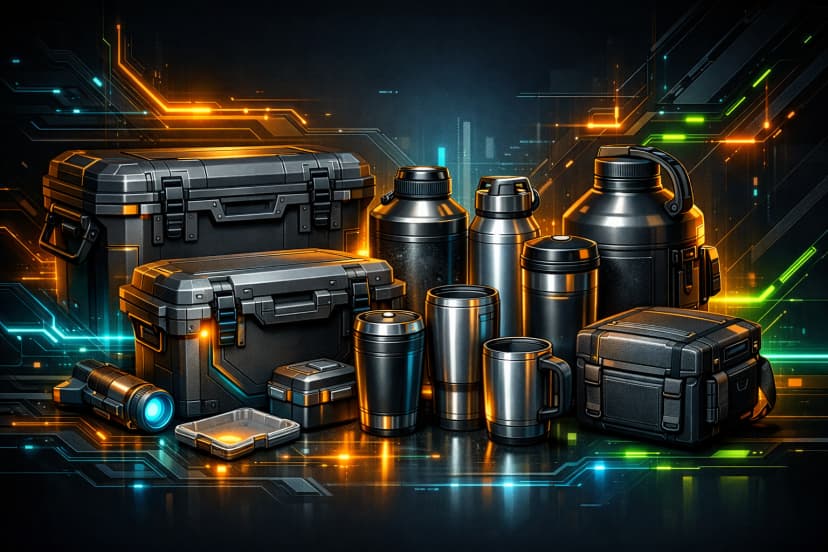
The Tundra hard cooler remains the product that established YETI's reputation. Its rotomolded or injection-molded construction, polyurethane insulation, freezer-quality gasket, and ice-retention design support the brand's premium performance positioning.
The Roadie family broadens the cooler platform toward portability. YETI introduced a redesigned Roadie 24 in 2025, while the Hopper and Daytrip collections address soft-cooler use cases. These products give YETI a ladder from large expedition-style coolers to lunch bags, totes, backpacks, and daily carry products.
Rambler is the flagship drinkware franchise. Its double-wall vacuum insulation, kitchen-grade 18/8 stainless steel, and No Sweat design support a clear functional message. The product family now covers bottles, jugs, tumblers, mugs, cups, food jars, bowls, barware, and tableware.
The product strategy is deliberately modular. YETI launches an anchor product, adds sizes and colorways, then attaches accessories and adjacent use cases. This structure helps a successful product remain commercially relevant beyond its initial launch window.
Innovation & Competitive Advantage
YETI's competitive advantage is primarily a brand, product, and distribution advantage rather than a manufacturing monopoly. The FY2025 10-K identifies patents, trademarks, copyrights, distinctive design, product performance, and brand reputation as important assets.
Management reported product satisfaction of approximately 98%, steady 12-month retention at yeti.com, and rising lifetime value. Nearly two-thirds of surveyed customers own products across multiple categories. Those figures support the idea that YETI is building an ecosystem rather than selling isolated items.
Products launched during the previous 24 months generally represented approximately 25%-30% of sales in key categories. That level of new-product contribution gives YETI a measurable innovation engine, while the legacy product base continues to generate repeat demand.
Digital tools add a smaller but useful layer to the moat. YETI launched Ranger, an AI-driven shopping assistant designed to improve product discovery and conversion, and also launched a TikTok shop to reach younger consumers while preserving its premium brand standards.
Operations & Supply Chain
YETI uses third-party manufacturing and logistics partners rather than owning factories. Core products are manufactured across China, Thailand, Malaysia, Vietnam, the Philippines, Mexico, and Poland. The company owns its molds and tooling, sets product specifications, and performs quality inspections at manufacturing and logistics sites.
The outsourced structure provides flexibility and limits fixed manufacturing investment. It also leaves YETI exposed to tariffs, freight costs, production capacity, supplier execution, and geopolitical disruption. The company identifies polyethylene, polyurethane foam, stainless steel, polyester fabric, zippers, magnets, plastics, and coatings as key materials.
Supply constraints are currently concentrated in soft coolers and bags. Management said demand exceeded supply through 2025 and Q1 2026, with additional capacity planned for the second half of 2026. That capacity could convert existing demand into revenue, provided production quality and logistics remain controlled.
Inventory management improved in Q1. Inventory declined 4% to $318M, while wholesale channel inventories remained aligned with demand. That is an important improvement for a seasonal company that pre-orders products before receiving firm customer orders.
Market Analysis
YETI participates in several overlapping markets, including outdoor recreation, housewares, home and garden, outdoor living, industrial products, and commercial gifting. The company's products can be used year-round, which broadens the addressable opportunity beyond traditional camping and fishing.
The U.S. remains the core market, representing approximately 79% of FY2025 sales. International revenue represented 21% and grew 16% during FY2025. In Q1 2026, U.S. sales rose 8% to $293.1M, while international sales increased 9% to $87.3M.
International growth is the clearest geographic expansion lever. Europe is benefiting from rising awareness and wider wholesale distribution. Japan is in an early ramp phase following the launch of YETI's e-commerce platform, while Southeast Asia is expanding and China and Korea are targeted for the second half of 2026.
Management projects international growth in the high teens to 20% range for the full year, compared with low-to-mid-single-digit U.S. growth. The gap creates upside if international execution remains disciplined, but it also raises the company's exposure to foreign exchange and local consumer conditions.
Like what you're reading?
Get full access to AI-powered research reports, market analysis, and portfolio tools.
YETI's customer base ranges from serious outdoor enthusiasts to consumers who value durability, design, and brand identity in everyday products. The original hard cooler was developed for hunting and fishing, but the current portfolio reaches commuters, travelers, fitness users, home cooks, families, corporate buyers, and pet owners.
The customer economics are strongest when a buyer moves across categories. Nearly two-thirds of surveyed customers now own products in multiple categories, while lifetime value at yeti.com continues to grow. Bags, soft coolers, sports hydration, food storage, and cookware give YETI more opportunities to deepen relationships.
Brand health also appears broad. Management reported increased U.S. awareness, consideration, and preference across coolers, drinkware, and bags, with bags reaching their highest tracked levels since 2022. Brand NPS remained healthy across demographic groups, and product satisfaction was approximately 98%.
Corporate buyers form a distinct customer group. Corporate sales declined in Q1 because of cautious ordering, order timing, and a slower global corporate environment. Management described the weakness as channel-specific and reported improving corporate-sales trajectory in Q2.
Competitive Landscape
YETI competes in coolers against Igloo, Coleman, Stanley, SharkNinja, and private-label products. In drinkware, the named competitors include Hydro Flask, Stanley, Owala, and HydroJug. The category is fragmented, and the FY2025 10-K identifies low barriers to entry.
The competitive battleground includes durability, performance, styling, price, brand recognition, retail access, and digital engagement. YETI's premium pricing works when consumers believe the product will last longer or perform better. Private-label and lower-priced alternatives challenge that logic by offering similar basic functions at lower prices.
Drinkware is the more crowded category. Stanley, Owala, Hydro Flask, HydroJug, and other brands compete for tumbler, bottle, and hydration occasions. YETI's response is a combination of product quality, color and format innovation, customization, retail reach, and a reputation built in coolers.
YETI's advantage is therefore durable but not impregnable. A brand can support premium pricing, but it cannot permanently ignore changing styles, retailer economics, or a consumer shift toward value. The 2026 growth in wholesale and Coolers & Equipment is positive evidence that the brand still has retail pull.
Macro & Geopolitical Landscape
Tariffs are the most visible near-term macro risk. Q1 2026 adjusted gross margin fell to 55.3%, down 200 basis points year over year, including a 280-basis-point tariff headwind. Management also quantified an approximately $0.09 unfavorable tariff impact on adjusted EPS.
YETI's 2026 outlook assumes gross margin of 56.5%-57.0%, with roughly 200 basis points of year-over-year pressure in the first half followed by approximately 50 basis points of expansion in the second half. The company cited sourcing, pricing, product mix, foreign exchange, and lower product costs as offsets.
Consumer-discretionary exposure remains a structural risk. Management specifically cited macro pressure in Australia and cautious ordering from corporate partners. International sales also benefited from approximately 800 basis points of foreign-exchange favorability in Q1, making reported growth stronger than the underlying local-currency trend.
The geographic sourcing footprint reduces dependence on one manufacturing country, but it does not eliminate trade risk. Products are manufactured across several Asian markets, Mexico, and Poland, and the FY2025 10-K identifies duties, customs requirements, tax rules, and import restrictions as material business factors.
Balance Sheet Health
▌Premium Members Only
YETI's balance sheet supports continued investment and share repurchases, giving the company room to fund growth while navigating tariff-related margin pressure.
Unlock the full analysis
Premium members get the complete breakdown — pick rationale, financial metrics, and recent earnings detail.
Management raised 2026 adjusted EPS guidance to $2.83-$2.89 and now expects 7%-8% sales growth, 8%-10% adjusted operating income growth, and $200M-$225M in free cash flow.
Unlock the full analysis
Premium members get the complete breakdown — pick rationale, financial metrics, and recent earnings detail.
YETI trades at 25.9x trailing earnings, 18.4x forward earnings, 1.7x PEG, and 2.2x EV/revenue, which supports a quality-growth rather than deep-value thesis.
Unlock the full analysis
Premium members get the complete breakdown — pick rationale, financial metrics, and recent earnings detail.
The report's valuation framework points to a $54 fair value, with the stock rated Buy for investors who can tolerate consumer-discretionary volatility.
Unlock the full analysis
Premium members get the complete breakdown — pick rationale, financial metrics, and recent earnings detail.
YETI enters the next phase with a stronger operating narrative than its FY2025 income statement suggests. Q1 2026 delivered 8.3% revenue growth, 19% wholesale growth, 11% Coolers & Equipment growth, and a raised full-year outlook. Those are concrete signs that demand has regained traction.
The investment case still requires discipline. Tariffs reduced Q1 adjusted EPS by approximately $0.09, DTC sales were flat, reported operating income fell 43%, and international growth benefited from foreign exchange. YETI's premium brand does not make it immune to consumer budgets or supply-chain arithmetic.
For a medium-term investor, the balance remains favorable. The company has a recognizable brand, broadening product platforms, a diversified channel model, improving international reach, a 7%-8% sales outlook, and a $200M-$225M free-cash-flow outlook. At the $54 fair-value anchor, the shares merit a Buy rating, with stronger conviction available at materially lower entry levels.
Why did YETI raise its 2026 outlook?
Management lifted 2026 adjusted EPS guidance to $2.83-$2.89 because sales momentum improved, led by 11% Q1 growth in Coolers & Equipment and 5% growth in Drinkware. The company also expects 7%-8% revenue growth, 8%-10% adjusted operating income growth, and $200M-$225M in free cash flow.
+What are the biggest risks for YETI stock?
Tariffs are the biggest near-term risk, cutting Q1 adjusted EPS by about $0.09 and reducing gross margin by 200 basis points. YETI also depends on consumer discretionary spending, so a slowdown in premium outdoor demand could delay the earnings recovery.
+Which YETI product categories are driving growth?
Coolers & Equipment is the faster-growing engine, with Q1 sales up 11% to $156.1M, while Drinkware rose 5% to $216.9M and returned to U.S. growth. Standout products include Daytrip, Camino, GoBox 1, and the Rambler franchise.
▌For Active Investors
Want Reports Like This on Any Stock?
Get AI-powered research reports, daily market intelligence, and a personal analyst in your pocket.