Align Technology (ALGN): Margin Recovery and Valuation Upside
Align Technology combines a strong balance sheet, improving margins, and a leading Invisalign franchise, but 2026 growth guidance remains modest. The stock looks attractive for moderate-risk investors if margin recovery and international demand continue to build.
Align Technology (ALGN) looks like a good investment right now, earning an overall grade of B+ and a Buy. Our fair value is $215, supported by a strong balance sheet, a leading Invisalign franchise, and improving quarterly margins even as 2026 revenue growth guidance stays modest at 3% to 4%.
Thesis
Align Technology (ALGN) merits a Buy rating for moderate-risk investors with a medium-term horizon. The case rests on a strong balance sheet, a leading Invisalign franchise, improving quarterly margins, and a forward P/E of 14.8 compared with a trailing P/E of 28.2. The main restraint is growth: management reaffirmed 2026 revenue growth of only 3% to 4%, while North American demand remained stable to modestly lower.
The operating evidence is better than the annual revenue trend alone suggests. Q1 2026 revenue reached $1.04B, up 6.2% year over year, Clear Aligner revenue rose 7.4% to $856M, and shipments reached a record 686,000 cases. Non-GAAP operating margin reached 21.5%, up 2.5 percentage points year over year, while full-year guidance calls for approximately 23.7%.
ALGN is not a pure high-growth story. Annual revenue increased from $3.86B in 2023 to $4.03B in 2025, while 2025 net income declined to $410.4M from $421.4M in 2024. The investment case therefore depends on margin recovery, international case growth, improved utilization, and continued adoption of the Align Digital Platform rather than on rapid top-line expansion alone.
Company Overview
Align Technology is a global medical device company founded in 1997 and headquartered in Tempe, Arizona. The company employs approximately 20,275 people and operates through two segments: Clear Aligner and Imaging Systems and CAD/CAM Services.
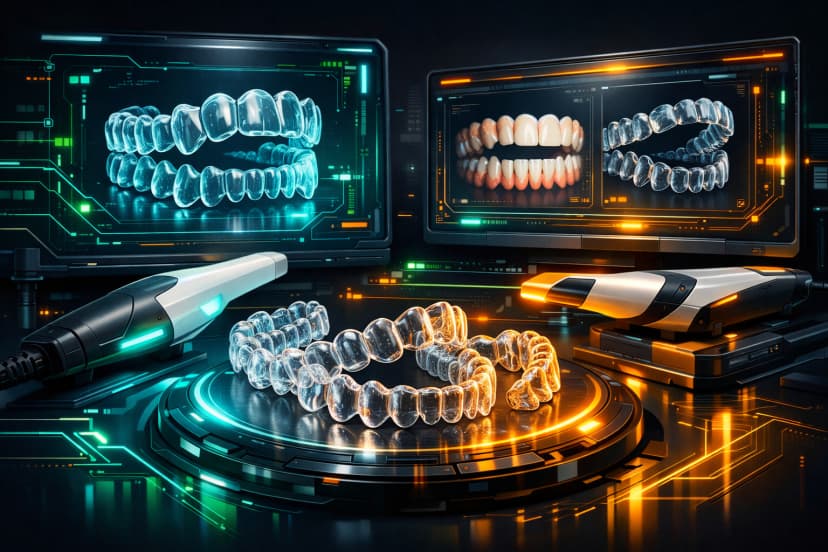
The company sells Invisalign clear aligners, Vivera retainers, iTero intraoral scanners, and exocad computer-aided design and manufacturing software. Invisalign received U.S. FDA 510(k) clearance in 1998, and more than 22 million people have been treated with the Invisalign System.
In 2025, Clear Aligner revenue represented 80.4% of total revenue, while Scanners and Services represented 19.6%. The platform connects patient scanning, treatment planning, aligner manufacturing, progress monitoring, retention, and restorative dental workflows.
▌Common Questions
Frequently asked questions
+Is ALGN stock a buy right now?
Yes, ALGN is a Buy for moderate-risk investors with a medium-term horizon. The case is driven by a strong balance sheet, a dominant Invisalign franchise, and improving margins, even though management only guided 2026 revenue growth to 3% to 4%.
+What is ALGN's fair value?
Align Technology's fair value is $215. That view reflects the report's valuation framework, which points to a forward P/E of 14.8, improving non-GAAP operating margins, and a business mix anchored by Clear Aligner revenue that still makes up about four-fifths of sales.
+Why does Align Technology still look attractive despite slow growth?
▌The Daily Briefing · Free
A new stock idea, every evening.
One stock worth watching each weekday, plus the analysis behind it. Free, in your inbox.
Align's stated strategy is to make Invisalign the treatment solution of choice for orthodontists, general dentists, and patients while positioning iTero as a preferred scanning system and exocad as a restorative dental software platform. That strategy gives ALGN exposure to both recurring treatment products and higher-value digital workflows.
Business Segment Deep Dive
Clear Aligner is the economic engine. Segment revenue was $3.25B in 2025, compared with $3.23B in 2024 and $3.20B in 2023. Its share of total revenue declined from 82.8% in 2023 to 80.4% in 2025 as the Systems and Services segment expanded.
Q1 2026 demonstrated renewed momentum. Clear Aligner revenue reached $856M, up 7.4% year over year and 2.1% sequentially. Shipments rose 6.7% year over year to a record 686,000 cases, and average selling price increased 1% to $1,250.
Imaging Systems and CAD/CAM Services generated $789.6M in 2025, up from $768.9M in 2024 and $662.9M in 2023. Q1 2026 revenue was $184.1M, up 0.9% year over year. The segment remains smaller and more cyclical because scanner sales are affected by capital equipment budgets, but software, service revenue, and scanner utilization add breadth to the business.
The mix shift matters because Align is becoming less dependent on a single treatment package. Still, Clear Aligner performance will continue to determine the company's earnings direction because it accounts for roughly four-fifths of annual revenue.
Get AI research on any stock
Instant reports, daily intelligence, and an AI analyst in your pocket.
Invisalign is a doctor-prescribed system built around a digital treatment plan and a series of custom-manufactured clear polymer aligners. The workflow begins with a scan or impression, moves through ClinCheck treatment planning, and ends with staged aligner delivery, progress monitoring, and Vivera retention.
More than 95% of Invisalign prescriptions are now submitted through digital scans. That figure supports faster treatment planning, reduces physical impression handling, and connects iTero scanning directly to the Invisalign workflow.
The product range spans Invisalign Express, Lite, Go, Moderate, Comprehensive, Invisalign First, retainers, touch-up cases, and products for growing patients. The Invisalign Palatal Expander and mandibular advancement with occlusal blocks extend the system into earlier intervention and Class II treatment.
Q1 adult treatment volume rose 7.8% to 449,000 patients, while teen and growing-kid starts increased 4.8% to 237,000. The adult result supports demand beyond purely cosmetic treatment, while the teen and kid portfolio expands the clinical range that doctors can treat with Invisalign.
Innovation & Competitive Advantage
Align's strongest advantage is the combination of brand, clinical data, software, and manufacturing scale. The company has treated more than 22 million people, giving ClinCheck algorithms a large treatment history from which to refine planning and improve predictability.
The Align Digital Platform links Invisalign, iTero, exocad, remote monitoring, oral health tools, and treatment planning. More than 125,000 active iTero scanners performed over 12 million digital scans in Q1 2026. Those installed-base figures support a workflow advantage that a low-price aligner provider cannot easily replicate with a single product.
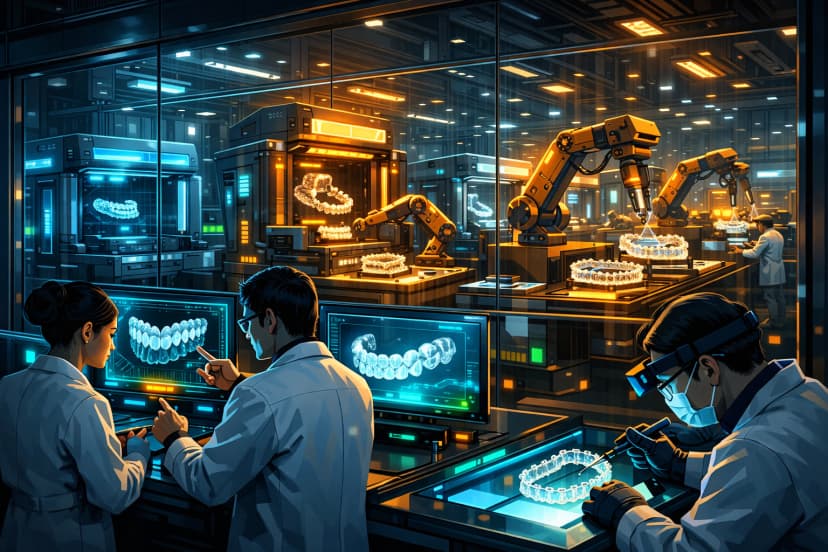
Innovation also targets manufacturing economics. Align completed the acquisition of Cubicure in January 2024 to expand direct 3D printing, reduce resin use, and eventually support a broader range of custom devices. Management said lower refinement rates, improved treatment predictability, and higher manufacturing throughput are contributing to margin expansion.
The 2025 launch of iTero Lumina restorative capabilities, iTero Lumina Pro, AI-enabled imaging tools, and the December 2025 limited commercial launch of mandibular advancement with occlusal blocks show a steady product cadence. The advantage is durable only if those products improve doctor utilization and patient conversion, but Q1 shipments and scanner activity provide evidence that the platform is gaining use.
Operations & Supply Chain
Align operates a global manufacturing and treatment-planning network spanning Mexico, China, Poland, Israel, Costa Rica, Germany, Spain, and Japan. That footprint supports international fulfillment but also exposes the company to freight, foreign exchange, tariffs, regulatory requirements, and regional disruption.
Q1 2026 capital expenditures were $30.8M, focused mainly on manufacturing capacity and facilities. Full-year capital expenditure guidance is $125M to $150M, covering technology upgrades, additional capacity, and maintenance.
Operating expenses rose 8.3% year over year to $594.6M in Q1, with legal settlement costs and employee compensation identified as the main drivers. That increase limited the benefit of the 1.4 percentage point improvement in overall gross margin.
Operating cash flow was $151.0M in Q1 and capital expenditures were $30.8M, producing quarterly free cash flow of $120.3M. The company also repurchased approximately 1.4 million shares between August 2025 and January 2026 at an average price of $143.85 and authorized up to another $200M of repurchases beginning around May 1, 2026.
Market Analysis
Align estimates that approximately 600 million people globally have malocclusion and could benefit from teeth straightening. Only about 22 million orthodontic cases begin worldwide each year, and Align estimates its share of those starts through orthodontists at approximately 10% globally.
That gap creates two distinct growth paths. Invisalign can take share from traditional wires and brackets within the existing case-start pool, and it can expand treatment access among patients who have not pursued orthodontic care. The company also estimates that almost all of the 22 million annual starts can be treated with Invisalign.
Q1 regional performance supports the international path. Clear Aligner volumes grew at double-digit rates in EMEA, APAC, and Latin America, while North America was modestly lower but described as stable. China, India, Korea, Japan, Iberia, Italy, the Nordics, the U.K., and Turkey were named as contributors to regional growth.
The market is not a free pass. Align's 2025 filing described a more pronounced increase in orthodontic starts using wires and brackets during Q2 2025, showing that clear aligner adoption can move against the long-term trend. Price competition also increases as digital manufacturing lowers entry barriers.
Like what you're reading?
Get full access to AI-powered research reports, market analysis, and portfolio tools.
Align sells primarily to orthodontists, general dentists, dental laboratories, and dental support organizations. Q1 2026 shipments to orthodontists increased 7.4% year over year, while shipments to general dentists increased 5.6%.
More than 88,000 doctors submitted Invisalign cases in Q1, an increase of 3% year over year. Doctor utilization also increased 3.4%. These two metrics are important because Align can grow through both more trained doctors and higher case volume per existing doctor.
Dental support organizations represented approximately one-quarter of global Clear Aligner volume in Q1, with double-digit volume growth across all regions. DSOs value standardized workflows, financing, training, and practice efficiency, which makes the Align platform particularly relevant to multi-office operators.
Affordability tools are becoming part of the customer proposition. Healthcare Financial Direct was live in more than 4,000 U.S. offices, while Invisalign Pay was used in a majority of Invisalign cases in Brazil. Treatment planning services also generated low double-digit case-start growth among participating general dentists in Canada.
Competitive Landscape
The primary competitor is still traditional orthodontic treatment using wires, brackets, elastics, expanders, and other appliances. Align also faces clear aligner competition from established medical device companies, laboratories, startups, dental support organizations, in-office manufacturing, and direct-to-consumer providers.
Named competitors in the broader market include Straumann Group, Dentsply Sirona and Byte, 3M Clarity Aligners, and Ormco products associated with Danaher. The competition spans both clinical treatment and price, which makes Invisalign's brand and doctor workflow important defenses.
Align's strongest relative position is breadth. Invisalign, iTero, exocad, Vivera retainers, ClinCheck, remote monitoring, and oral health software create an integrated stack. Competitors can attack individual products, but replacing the entire workflow requires a doctor to change scanning, planning, treatment, and laboratory processes at once.
The counterargument is price. Management specifically described lower-priced products, including streamlined configurations and touch-up cases, as tools to improve adoption and compete with traditional braces and lower-cost aligner suppliers. That approach can protect volume, but it places greater importance on manufacturing efficiency and utilization.
Macro & Geopolitical Landscape
Align's products are elective or timing-sensitive dental treatments, so patient traffic, financing conditions, and consumer sentiment affect demand. Q1 management cited less patient traffic among U.S. doctor customers, while the EMEA impact from Middle East military action was immaterial during the quarter.
Management incorporated some conflict-related pressure into Q2 guidance. Worldwide revenue is expected at $1.04B to $1.06B, up approximately 3% to 5% year over year, with Clear Aligner volume up sequentially and year over year and average selling price flat.
Foreign exchange helped Q1 revenue by approximately $44.9M year over year, or 4.5%, but reduced overall gross margin by 0.4 percentage points. The same global footprint that supports international growth therefore creates earnings sensitivity when currencies move.
Tariffs, freight costs, oil and gas supply disruptions, and further regional escalation are identified business risks. The 2026 guidance framework assumes no additional effects beyond those already incorporated, which gives the outlook a cautious rather than aggressive character.
Balance Sheet Health
▌Premium Members Only
Cash and investments of $1.37B against total debt of $1.16B leave Align with a net cash position, while the current ratio of 1.7 and quick ratio of 1.4 point to solid liquidity.
Unlock the full analysis
Premium members get the complete breakdown — pick rationale, financial metrics, and recent earnings detail.
Q1 2026 revenue rose 6.2% to $1.04B and non-GAAP operating margin expanded to 21.5%, but 2025 net income still slipped to $410.4M from $421.4M a year earlier.
Unlock the full analysis
Premium members get the complete breakdown — pick rationale, financial metrics, and recent earnings detail.
Management reaffirmed 2026 revenue growth of just 3% to 4% and expects non-GAAP operating margin around 23.7%, signaling a slower top-line path with margin support.
Unlock the full analysis
Premium members get the complete breakdown — pick rationale, financial metrics, and recent earnings detail.
A forward P/E of 14.8 versus a trailing P/E of 28.2 suggests the market is already discounting slower growth, even as the stock screens cheaper than its recent earnings history.
Unlock the full analysis
Premium members get the complete breakdown — pick rationale, financial metrics, and recent earnings detail.
The report’s valuation framework centers on a $215 fair value, with upside and downside bands stretching from $145 in a strong-buy case to $285 in a strong-sell case.
Unlock the full analysis
Premium members get the complete breakdown — pick rationale, financial metrics, and recent earnings detail.
Align Technology combines a category-leading Invisalign brand with iTero scanners, exocad software, proprietary treatment planning, and a large clinical data history. Q1 2026 provided concrete evidence of operating resilience: revenue reached $1.04B, Clear Aligner shipments reached 686,000 cases, gross margin improved to 70.8%, and non-GAAP operating margin reached 21.5%.
The investment is not without friction. Annual revenue growth has been restrained, 2025 net income fell to $410.4M, North American demand was stable to modestly lower, and traditional braces and lower-priced aligners remain credible alternatives. The balance sheet and capital return program reduce financial risk, but they do not remove execution risk.
At a forward P/E of 14.8 and a PEG ratio of 0.9, ALGN has enough valuation support for a Buy rating, provided the margin recovery and international volume growth continue. The $215 fair value estimate reflects a measured view: Align has the tools to compound earnings, but the market should demand proof that platform strength can translate into faster and more durable revenue growth.
The stock can still work because Q1 2026 revenue grew 6.2% to $1.04B, Clear Aligner revenue rose 7.4% to $856M, and operating margin expanded to 21.5%. Those gains suggest the earnings power is improving even if annual revenue growth is only expected to be 3% to 4%.
+What are the biggest risks for ALGN investors?
The main risk is that growth remains muted, especially in North America, where demand was described as stable to modestly lower. The company also remains heavily dependent on Clear Aligner, which accounted for 80.4% of 2025 revenue.
+How strong is Align Technology's balance sheet?
Align's balance sheet is strong, with $1.37B in cash and investments versus $1.16B of total debt. The current ratio of 1.7 and quick ratio of 1.4 indicate solid liquidity and financial flexibility.
▌For Active Investors
Want Reports Like This on Any Stock?
Get AI-powered research reports, daily market intelligence, and a personal analyst in your pocket.