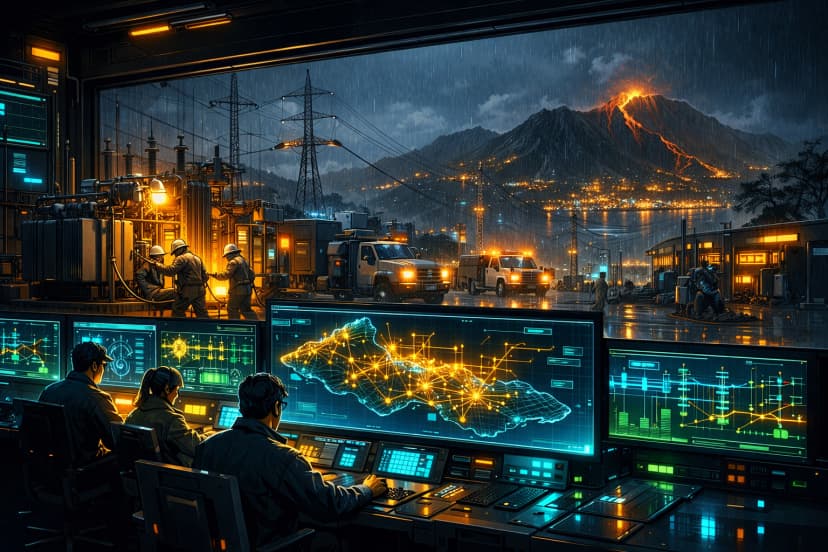
Hawaiian Electric Industries (HE): Recovery Story With Heavy Risks
Hawaiian Electric is a regulated utility recovery story with improving legal clarity after the Maui settlement, but leverage, weak earnings, and heavy capital needs keep it in Hold territory.
Hawaiian Electric Industries (HE) is earning an overall grade of C+ and looks like a Hold right now. The stock has support from its regulated monopoly, the Maui settlement progress, and a proposed 5.3% base-rate increase, but weak earnings consistency and financing needs keep the risk/reward balanced. Our fair value estimate is $13.
Thesis
Hawaiian Electric Industries (HE) is a high-risk utility recovery story moving from wildfire litigation toward regulated rate recovery, grid investment, and balance-sheet repair. The Maui settlement reached its pivotal payment stage on April 10, 2026, when HE made the first $479M installment of four annual payments. Moody’s then upgraded Hawaiian Electric to Ba1 from Ba2 and the holding company to Ba2 from Ba3. Those events reduce the most immediate legal overhang, but they do not erase the financing burden.
The investment case rests on three facts. HE supplies electricity to about 95% of Hawaii’s population through a regulated utility franchise, management has proposed a 5.3% consolidated base-rate increase phased across 2027 and 2028, and the company is pursuing a major grid and generation investment program. The counterweight is equally concrete: 2026 core EPS fell to $0.18 from $0.23 in the first quarter of 2025, management expects operating and maintenance costs to rise significantly faster than inflation, and future settlement payments will require additional debt and equity financing.
At the latest quoted price of $13.34, HE fits a moderate-risk portfolio only as a small recovery position, not as a conventional defensive utility holding. The regulated monopoly and prospective rate reset provide support, while weak earnings consistency, elevated leverage, and wildfire-related regulatory exposure restrain upside. The appropriate stance for a medium-term investor is Hold.
Company Overview
Hawaiian Electric Industries, founded in 1891 and headquartered in Honolulu, operates Hawaiian Electric Company and its utility subsidiaries. The business generates, purchases, transmits, distributes, and sells electricity across Oahu, Hawaii Island, Maui, Lanai, and Molokai. The utilities operate five separate grids, an important distinction from mainland systems that can move power across large interconnected regions.
▌Common Questions
Frequently asked questions
+Is HE stock a buy right now?
HE is a Hold right now, not a Buy. The regulated utility franchise and improving Maui settlement visibility are positives, but weak earnings, heavy capital needs, and financing risk keep the stock from offering enough margin of safety.
+What is HE's fair value?
HE's fair value is $13. We arrive at that view using the report's valuation framework, which places the stock between the $11 buy level and the $15 sell level, while weighing the regulated rate-reset potential against wildfire exposure, rising O&M costs, and the need for additional financing.
+Why is Hawaiian Electric still rated Hold after the Maui settlement progress?
▌The Daily Briefing · Free
A new stock idea, every evening.
One stock worth watching each weekday, plus the analysis behind it. Free, in your inbox.
HEI sold American Savings Bank on December 31, 2024, and has been simplifying its structure around regulated electric operations. Chief Executive Officer Scott Seu described the company as a streamlined business focused solely on regulated utility operations after the Maui settlement milestone. That narrower structure makes the investment case easier to analyze, but it also concentrates exposure to Hawaii’s regulators, weather, fuel markets, and wildfire policy.
The business is economically essential but financially capital intensive. Revenue was $3.1B in 2025, while net income was $126.3M and net margin was 4.1%. The utility model produces durable customer access and regulated recovery mechanisms, yet returns depend on the Hawaii Public Utilities Commission approving rates and allowing recovery for safety, resilience, and generation investments.
Business Segment Deep Dive
Electric energy sales are the clear economic center of HE. The 2025 revenue mix was broad across customer classes rather than dependent on one account group:
Large light and power: $1.1B, or 35.0% of 2025 revenue.
Residential: $992.4M, or 32.1% of revenue.
Commercial: $971.8M, or 31.5% of revenue.
Other electric sales, product and service revenue, and regulatory revenue made up the balance.
The revenue base fell from $3.22B in 2024 to $3.09B in 2025. That decline followed the sale of the bank and the company’s post-wildfire restructuring, so the headline change does not represent a simple deterioration in electric demand. Still, the first quarter of 2026 produced revenue of $746.4M, only slightly above $744.1M in the year-earlier quarter, showing limited near-term top-line momentum.
The regulatory revenue line was negative $29.5M in 2025, compared with negative $2.6M in 2024. Management also expects the fuel cost risk-sharing mechanism to create its maximum penalty in 2026 because procured fuel costs have moved above benchmark levels. Fuel costs are substantially passed through to customers, but the billing lag and the risk-sharing mechanism still create temporary pressure on cash flow and earnings.
Get AI research on any stock
Instant reports, daily intelligence, and an AI analyst in your pocket.
HE’s flagship offering is dependable electricity service across a difficult island geography. Its value is measured less by a consumer product launch than by grid availability, wildfire resilience, fuel security, and the ability to integrate renewable generation without destabilizing service. That makes reliability spending a commercial necessity and a regulatory investment at the same time.
The Waiau repowering project is the largest named generation initiative in the current plan. The project has a revised total cost estimate of $1.2B, including $847M approved for Exceptional Project Recovery Mechanism recovery, a $61M inflation adjustment, and $247M intended for recovery in a later rate proceeding. HE contracted for six gas turbines in April 2026, with two turbines scheduled for service in each of 2029, 2031, and 2033.
Waiau improves firm capacity, but it also creates execution and recovery risk. Management expects $157M of Waiau capital expenditure in 2026, up from a previous expectation of $90M. HE will accrue allowance for funds used during construction at an approved weighted average cost of capital of about 7.4% on Oahu, yet a portion of the project cost is not scheduled for recovery until a later rate process.
Innovation & Competitive Advantage
HE’s strongest competitive advantage is structural rather than technological. Its regulated utility subsidiaries serve about 95% of Hawaii’s population, and island geography makes duplicating five electric grids uneconomic. Customers cannot realistically switch to another retail network, giving HE a durable service-territory moat.
The company’s regulatory framework adds a second layer of protection. Performance-based regulation includes an annual revenue adjustment and other mechanisms intended to reduce the effect of customer-volume changes. Fuel and purchased-power costs also have recovery clauses. These tools help stabilize the utility model, although the $29.5M negative regulatory revenue line in 2025 and the expected 2026 fuel penalty show that regulation is a shock absorber, not an impenetrable wall.
HE is also using solar, storage, electrification, and electric-vehicle adoption to reshape the system. Management links solar plus storage to lower bill volatility, while the April 2026 Wildfire Mitigation Plan update establishes a recurring two-year planning cycle. The combination of regulated access, local operating knowledge, and a mandated clean-energy transition is a meaningful moat. The limitation is that rooftop solar can reduce traditional utility sales and force HE to invest in a more complex grid.
Operations & Supply Chain
Operations are exposed to weather because the company manages separate island grids and relies on imported fuel. Heavy rain and damaging winds in February and March 2026 required 35 days of emergency response. Kona Low storms caused an estimated $2B in damage across multiple islands, and higher storm response, vegetation management, station maintenance, insurance, labor, and cybersecurity costs reduced first-quarter utility earnings.
Fuel procurement is a working-capital issue even when the underlying cost is passed through. HE pays for fuel when delivered, while customer rates reflect prior-month average prices with a lag of roughly one to two months. Management cited about one month of fuel inventory and customer receivables collection of roughly 20 to 25 days. That timing explains why a geopolitical oil shock can pressure liquidity before the company recovers the cost through rates.
Supply-chain execution improved for Waiau after HE signed turbine purchase contracts to secure production slots and reduce exposure to non-tariff price increases. Baseline capital spending is roughly $350M to $400M annually, separate from larger individually recovered projects. This creates a substantial construction pipeline, but the $247M Waiau recovery gap and the need to finance settlement installments keep capital allocation under close scrutiny.
Market Analysis
Hawaii’s electric market is defined by high renewable penetration, isolated grids, and a strong need for firm capacity. In 2025, renewables supplied about 34% of statewide electricity generation, with solar contributing about 24%. Small-scale customer-sited solar represented roughly two-thirds of solar generation, making rooftop systems a major force in the state’s supply mix.
The investable market is therefore shifting from simple electricity volume growth toward generation replacement, storage, grid-forming resources, and resilience spending. HE’s July 2026 Integrated Grid Planning solicitation seeks about 1,650 GWh of variable renewable energy, 465 MW of grid-forming resources, 111 MW of firm generation, and up to another 500 MW of firm Oahu generation. These requirements create a large project pipeline inside HE’s regulated service territory.
Demand also has a constructive long-term angle. HE says electricity demand is growing at its fastest pace in two decades as transportation and industrial processes electrify, while Oahu uses more than 70% of Hawaii’s generated electricity. That demand supports investment, but the 2025 revenue decline and nearly flat first-quarter 2026 revenue show that the growth opportunity has not yet translated into strong consolidated earnings momentum.
Like what you're reading?
Get full access to AI-powered research reports, market analysis, and portfolio tools.
HE serves a balanced mix of residential households, commercial communities, resorts, agricultural operations, and United States Armed Forces installations. In 2025, residential customers contributed 32.1% of revenue, commercial customers 31.5%, and large light and power customers 35.0%. That mix reduces dependence on any single customer category, although it also gives affordability and economic activity a direct effect on rate politics.
Customer affordability is central to the current investment debate. On April 6, 2026, HE introduced interest-free payment plans for up to six months and $50 bill credits for customers in areas more dependent on diesel generation. Management also said Hawaii’s average household energy burden is below the national average, supported by electrification, rooftop solar, and electric-vehicle adoption.
The proposed rate rebasing would increase consolidated base rates by about 5.3%, phased over two years. Management estimates the change would add $8 to $12 to the average monthly customer bill in 2027 and another $2 to $3 in 2028. That proposal attempts to fund safety and reliability work without creating a single sharp bill increase, but the same affordability pressure could limit the final regulatory outcome.
Competitive Landscape
HE faces little direct retail competition inside its primary service territories. The more important competitors are rooftop solar providers, battery-storage developers, independent power producers, and energy-service companies. These alternatives compete for customer investment and can reduce the amount of electricity purchased through the traditional utility model.
Hawaii’s customer-sited solar base is unusually important. The state had about 1,539 MW of solar capacity at the end of 2025, and small-scale solar was almost twice utility-scale solar. HE must therefore compete through system design and regulation rather than retail pricing alone. Its support for solar plus storage gives the company a role in integrating distributed resources, but it must also recover grid costs as customers produce more electricity themselves.
For capital-market comparison, investors typically place HE beside larger regulated utilities such as Duke Energy, Southern Company, Dominion Energy, and NextEra Energy. Those companies benefit from broader geographic footprints and greater financing scale. HE’s local monopoly is stronger than its size suggests, but its $2.2B market capitalization and Hawaii-only concentration leave less room for operational mistakes.
Macro & Geopolitical Landscape
The most direct macro risk is oil. Management linked the recent rise in global fuel prices to escalating geopolitical tension and the Iran conflict. Because Hawaii operates isolated grids and uses fuel for generation, the company faces a more immediate fuel-price transmission than a mainland utility with extensive gas, coal, nuclear, and interregional power options.
The near-term earnings effect is amplified by the fuel cost risk-sharing mechanism. HE expects the maximum penalty under that mechanism in 2026, while higher fuel payments also raise working-capital needs before customer recovery. The company’s payment plans and bill credits address customer stress, but they can make the affordability and regulatory balancing act more difficult.
Climate and disaster risk is not theoretical for HE. The August 2023 Maui wildfires produced about $1.9B of pretax wildfire liabilities in 2024, while the 2026 Kona Low storms generated an estimated $2B of damage across multiple islands. The PUC’s wildfire liability-cap rulemaking has been associated with an 18- to 24-month expected process, and rating agencies have identified the liability cap, wildfire recovery fund, rate rebasing, and system risk reduction as inputs to future credit decisions.
Balance Sheet Health
▌Premium Members Only
Moody’s upgraded HE to Ba1 from Ba2 after the first $479M Maui settlement payment, but the company still faces additional debt and equity financing needs to fund future settlement installments and capital spending.
Unlock the full analysis
Premium members get the complete breakdown — pick rationale, financial metrics, and recent earnings detail.
Management is targeting a 5.3% consolidated base-rate increase phased across 2027 and 2028, but operating and maintenance costs are expected to rise significantly faster than inflation.
Unlock the full analysis
Premium members get the complete breakdown — pick rationale, financial metrics, and recent earnings detail.
At $13.34, HE trades just above our $13 fair value, leaving only modest upside for a utility still burdened by wildfire-related risk and elevated leverage.
Unlock the full analysis
Premium members get the complete breakdown — pick rationale, financial metrics, and recent earnings detail.
The report’s price framework centers on $13 fair value, with $11 as a buy level and $15 as a sell level, placing the current price in the middle of the range.
Unlock the full analysis
Premium members get the complete breakdown — pick rationale, financial metrics, and recent earnings detail.
HE has crossed an important legal milestone, but the stock remains a balance-sheet and regulatory recovery situation rather than a finished turnaround. The $479M first settlement payment, Moody’s upgrades, Waiau approval, and proposed 5.3% rate increase improve the strategic picture. The 2026 earnings decline, $452.8M quarter-end cash balance, $2.4B debt load, and planned future financing keep the risk profile elevated.
For a medium-term, moderate-risk investor, patience matters more than narrative excitement. HE’s monopoly franchise and Hawaii’s clean-energy buildout create durable assets, but the market still needs evidence that rate recovery can offset rising operating costs and capital demands. A Hold is justified at $13.34, while a materially lower entry point would improve the risk-reward balance.
The first $479M settlement installment and Moody’s upgrade to Ba1 reduced the most immediate legal overhang. Even so, the company still faces elevated leverage, future settlement payments, and a capital-intensive grid and generation buildout that could pressure cash flow.
+What could drive HE higher from here?
A successful 5.3% consolidated base-rate increase phased across 2027 and 2028 would help, along with recovery on major projects like the $1.2B Waiau repowering plan. Better execution on rate recovery and lower-than-expected financing dilution would also support upside.
+What are the biggest risks for HE investors?
The biggest risks are wildfire-related regulatory exposure, rising operating and maintenance costs, and the need to fund settlement payments and capital projects with more debt and equity. The report also notes that the fuel cost risk-sharing mechanism could create its maximum penalty in 2026.
▌For Active Investors
Want Reports Like This on Any Stock?
Get AI-powered research reports, daily market intelligence, and a personal analyst in your pocket.