Dorian LPG combines record VLGC earnings power with a modern fleet and a solid balance sheet, but the stock still depends on freight-rate normalization. The report supports a Buy for investors willing to accept shipping-cycle volatility.
Dorian LPG (LPG) looks attractive right now, earning an overall grade of B+ and a Buy rating. Our fair value is $51.80, reflecting strong near-term freight rates, a modern fleet, and a balance sheet that helps cushion the cycle, even as earnings are likely to normalize.
Thesis
Dorian LPG (LPG) offers a compelling medium-term income and value profile, supported by strong VLGC freight rates, a modern fleet, high recent margins, and a substantial capital-return record. The stock trades at 6.8x trailing earnings and 6.3x forward earnings, while the published free-cash-flow yield is 13.9%. Those figures are attractive, but they reflect a cyclical shipping business rather than a steady compounder.
The central tension is earnings normalization. TTM EPS is $7.54, while the next-year EPS estimate is $3.59 and the analyst estimate for fiscal 2027 is $8.10. Dorian's recent operating performance is powerful, yet the earnings history shows only 2 beats in 8 reported quarters. That combination supports a Buy rating for a moderate-risk investor who accepts freight-rate volatility, but it argues against treating the current earnings multiple as permanent.
The balance sheet gives the thesis a useful margin of safety. The June 30, 2026 quarterly statement showed $342.1M of cash against $552.1M of debt, while the annual balance sheet showed a 0.53 debt-to-equity ratio and a 2.67 current ratio. Management also reported a 5.1% all-in debt cost, an undrawn $41M revolver, and one debt-free vessel. Fleet renewal, dividend payments, and freight-rate normalization remain the principal variables separating a good shipping investment from a great one.
Company Overview
Dorian LPG is a pure-play owner and operator of very large gas carriers, or VLGCs, that transport liquefied petroleum gas worldwide. The company was incorporated in 2013, is headquartered in Stamford, Connecticut, and trades on the NYSE under LPG. Its leadership includes Chairman, President, and CEO John C. Hadjipateras, CFO Theodore B. Young, COO Alexander C. Hadjipateras, and Chief Commercial Officer Tim T. Hansen.
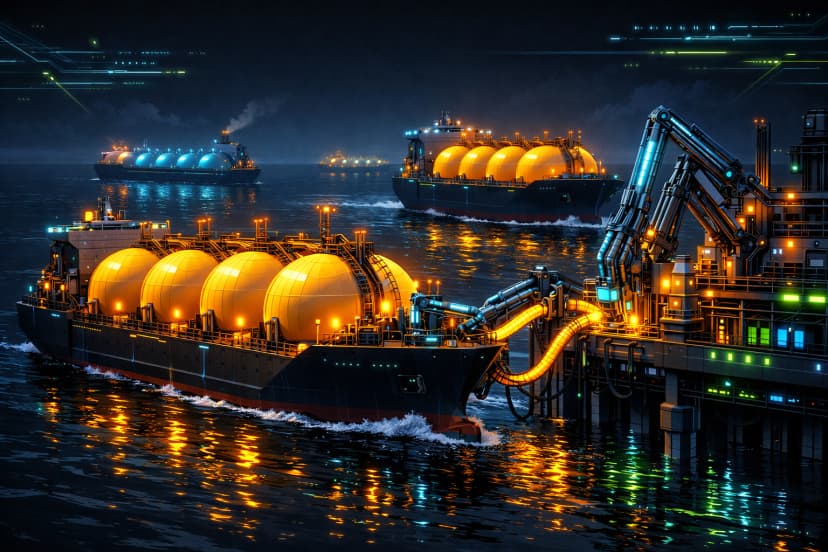
The May 22, 2026 fleet listing included 27 vessels with aggregate capacity of about 2.3M cubic meters and an average age of 9.6 years. That fleet included 21 owned vessels and six time-chartered-in vessels, with the Helios Pool operating 31 VLGCs in total. Dorian's fleet contains ECO-design ships, scrubber-equipped vessels, dual-fuel vessels, and ammonia-capable tonnage.
▌Common Questions
Frequently asked questions
+Is LPG stock a buy right now?
Yes, Dorian LPG is a Buy for investors who can tolerate shipping-cycle volatility. The report gives it an overall grade of B+ because strong VLGC freight rates, a modern fleet, and a solid balance sheet outweigh the risk of earnings normalization.
+What is LPG's fair value?
Dorian LPG's fair value is $51.80. We arrive at that by anchoring to the report's valuation framework, which sits between the $44 Buy level and the $60 Sell level, while factoring in 6.3x forward earnings, a 13.9% free-cash-flow yield, and the company’s strong current freight environment.
+
▌The Daily Briefing · Free
A new stock idea, every evening.
One stock worth watching each weekday, plus the analysis behind it. Free, in your inbox.
The business is concentrated by design. Dorian focuses on LPG shipping rather than spreading capital across crude, product tankers, LNG, or terminals. That specialization provides operating expertise and a clear commercial identity, but it also ties revenue, asset values, and dividends closely to VLGC supply, LPG trade flows, and daily charter rates.
Business Segment Deep Dive
Dorian presents the business primarily through fleet and commercial operating metrics rather than a diversified set of corporate divisions. The main revenue channel is the Helios Pool, a 50-50 joint venture with MOL Energia, a subsidiary of Mitsui O.S.K. Lines. The pool commercially manages participating vessels across spot voyages, contracts of affreightment, and shorter time charters.
The Helios structure is central to the investment case. About 97% of fiscal 2025 revenue and 99% of fiscal 2026 revenue came through the pool. The arrangement gives Dorian broader commercial reach and shared market coverage, while the related-party structure creates dependence on pool economics and execution. In shipping, a larger commercial network can be valuable because a vessel's next profitable cargo is often a positioning problem, not simply a rate-sheet problem.
Dorian also uses time-chartered-in vessels to expand commercial capacity without purchasing every ship outright. Six time-chartered-in vessels generated gross charter hire expense of $22.6M, or $41,418 per TCE-in day, in fiscal Q1 2027. Management said those vessels contributed positively to quarterly profits, showing that charter-in activity can add operating leverage when market rates exceed contracted hire costs.
Get AI research on any stock
Instant reports, daily intelligence, and an AI analyst in your pocket.
Dorian's flagship product is transportation capacity aboard large, specialized LPG carriers. The commercial output is measured through time charter equivalent revenue, utilization, available days, and pool profitability. In fiscal Q1 2027, Dorian reported TCE revenue per available day of $75,926, the highest TCE rate in the company's operating history. The Helios Pool reported more than $75,100 per day across its overall portfolio.
The latest quarterly financial statement showed revenue of $187.9M and net income of $138.3M for the quarter ended June 30, 2026. Adjusted EPS was $2.52, compared with $1.89 in the immediately preceding quarter and $1.11 in the February 2026 quarter. The progression captures the earnings power of the fleet during a strong freight environment, although it also highlights the sharp sensitivity of results to market conditions.
Dorian delivered the 93,000-cubic-meter dual-fuel VLGC/Ammonia Carrier Areion in March 2026. It also contracted a 90,000-cubic-meter dual-fuel Panamax VLGC at Hyundai Heavy Industries for mid-2029 delivery. Areion expands the high-specification portion of the fleet, while the new order extends the renewal program into a market where fuel efficiency and emissions performance increasingly influence charterer decisions.
Innovation & Competitive Advantage
Dorian's competitive advantage is practical rather than flashy: efficient vessels, specialized commercial management, and access to a large pool of cargoes. As of the May 22, 2026 fleet listing, 16 ECO VLGCs, including one time-chartered-in ECO vessel, and one VLGC/Ammonia Carrier had scrubbers. The company also operated six dual-fuel LPG vessels after the delivery of Areion.
Scrubber economics were visible in fiscal Q1 2027. Net savings amounted to approximately $1,971 per calendar day per scrubber vessel. The high-sulfur fuel oil and low-sulfur fuel oil differential averaged $118 per metric ton, while the LPG and very-low-sulfur fuel oil differential stood at about $369 per metric ton. These spreads give Dorian's vessels a cost advantage when fuel prices remain elevated.
The 2029 newbuilding will include a shaft generator that uses mechanical energy from the main propulsion system to improve power efficiency and reduce emissions. Dorian also has ammonia-loading capability on several vessels. These features do not eliminate commodity-cycle risk, but they strengthen charterability as customers place more weight on fuel consumption, emissions, and vessel compliance.
Operations & Supply Chain
Dorian controls commercial management for its vessels and provides in-house technical management for its owned fleet. The Helios Pool extends that commercial platform across 31 VLGCs, improving cargo matching and geographic coverage. In fiscal Q1 2027, more than 75% of the 29-vessel Helios Pool fleet had spot exposure, leaving Dorian positioned to capture strong voyage economics rather than locking the entire fleet into fixed rates.
The company is actively reshaping the fleet. Dorian sold Cobra in May and prepaid $16.5M of debt tied to the vessel. It completed the sales of Corsair and Constellation in July for approximately $166.4M of net proceeds, with $48.1M of associated debt repaid. Management also signed an agreement to sell Clermont and described the renewal program as conservative.
The operational cost base remains manageable relative to recent revenue. Daily operating expense was $10,308 in fiscal Q1 2027, excluding dry-docking costs. Management placed expected cash cost for the coming year at approximately $26,000 to $27,000 per day, excluding Captain John's planned fourth-quarter dry dock. Core G&A was about $7.3M for the quarter after excluding noncash compensation and $4.2M of incentive compensation.
Market Analysis
The VLGC market benefits from the growth of U.S. LPG exports and the long distances between major export and import markets. The U.S. accounted for approximately 65% of global seaborne LPG exports in the latest quarterly discussion, up from less than 50% a year earlier. U.S. exports reached nearly 20.8M tons, up 20% year over year.
Long-haul trade supports vessel demand because a ship can earn more days per cargo when U.S. Gulf volumes travel to Asia. U.S. Gulf cargoes to India increased about 138% in April and May 2026 compared with the February and March period. High U.S. production and increased terminal capacity also produced a quarterly export record that was almost 1.8M tons above the previous quarterly record.
Supply remains the counterweight. Dorian's 2025 filing counted approximately 402 VLGCs with 108 vessels on order for delivery by the end of 2029. A growing orderbook can reduce scarcity and pressure day rates, especially if deliveries arrive while LPG demand or export growth slows. The investment case therefore rests on trade-mile growth and disciplined fleet expansion keeping pace with new capacity.
Like what you're reading?
Get full access to AI-powered research reports, market analysis, and portfolio tools.
Dorian serves three broad customer groups: integrated energy companies, commodity traders, and LPG importers. Named customers include Exxon Mobil, Chevron, Shell, Equinor, Total, Sunoco, Glencore, Itochu, Gunvor, Vitol, Indian Oil, SK Gas, E1, and Astomos Energy. This customer mix gives Dorian exposure to producers, merchants, and end-market buyers rather than a single type of charterer.
Charterers select vessels based on rate, location, size, age, condition, reliability, and regulatory profile. Dorian's 9.6-year average fleet age as of May 2026 compared favorably with the 11.4-year global VLGC fleet average cited in the company's filing. That difference matters when a customer is balancing freight cost against fuel consumption, inspection standards, and cargo-handling requirements.
Customer concentration still deserves attention because the business depends on a finite group of large counterparties and on the Helios Pool's commercial performance. The pool structure improves reach, but it also means that changes in pool participation, customer relationships, or pool profitability can flow through to nearly the entire revenue base.
Competitive Landscape
Dorian operates in a fragmented VLGC market with meaningful scale at the top. Its filing identified BW LPG, NYK Line, and Petredec as major competitors. The worldwide fleet had approximately 115 owners, while the top 10 owners controlled 41% of vessels by count as of May 2025.
BW LPG is the largest listed comparison, with about 50 VLGCs and 22 dual-fuel vessels according to its 2025 annual report. Dorian's 27-vessel fleet is smaller, but its pure-play focus, Helios Pool access, and high share of ECO, scrubber, and dual-fuel tonnage give it a credible position among specialized owners.
Scale favors BW LPG in fleet coverage and commercial breadth. Dorian counters with a focused fleet, in-house technical management, and a renewal program aimed at moving away from a concentration of 2015-built vessels. The competitive contest is therefore less about owning the most ships and more about owning efficient ships that can secure profitable employment across changing trade routes.
Macro & Geopolitical Landscape
The latest earnings period was shaped by the de facto closure of the Strait of Hormuz. Middle East liftings fell to roughly 3.4M tons, down more than 70% from the same period a year earlier. India and Indonesia shifted sourcing toward the U.S. Gulf, increasing sailing distances and ton-mile demand.
The disruption also raised Panama Canal congestion and auction prices. Ships carrying energy cargoes competed for scarce transits, while other vessels routed around the Cape of Good Hope. Average bunker prices increased about 36% quarter over quarter across a basket of major fuel hubs. Higher costs reduced some of the benefit from record freight rates, but Dorian's scrubbers and dual-fuel vessels provided operating support.
Freight rates fell from record highs after the mid-June U.S.-Iran ceasefire memorandum, but management described the peace prospects as fragile and noted that ceasefire talks broke down in early July. A lasting reopening of Middle East supply routes would remove part of the disruption premium. At the same time, the CEO argued that restored trade would also bring replenishment activity and additional traffic, rather than automatically producing a collapse in demand.
Balance Sheet Health
▌Premium Members Only
Cash of $342.1M against $552.1M of debt, plus a 2.67 current ratio and a 0.53 debt-to-equity ratio, gives Dorian LPG a meaningful cushion even in a volatile shipping market.
Unlock the full analysis
Premium members get the complete breakdown — pick rationale, financial metrics, and recent earnings detail.
TTM EPS of $7.54 drops to a next-year estimate of $3.59 before rebounding to $8.10 in fiscal 2027, underscoring how quickly VLGC earnings can normalize.
Unlock the full analysis
Premium members get the complete breakdown — pick rationale, financial metrics, and recent earnings detail.
At 6.8x trailing earnings, 6.3x forward earnings, and a 13.9% free-cash-flow yield, the stock screens cheap, but only if freight rates stay supportive.
Unlock the full analysis
Premium members get the complete breakdown — pick rationale, financial metrics, and recent earnings detail.
Dorian LPG has delivered the ingredients value investors want from a cyclical shipping company: strong cash generation, high returns on equity, a modern fleet, meaningful shareholder distributions, and declining leverage. Fiscal 2026 revenue reached $481.5M, fiscal 2026 net income reached $193.7M, and fiscal Q1 2027 produced $138.3M of net income on $187.9M of revenue.
The investment is not a bond substitute. Ninety-nine percent of fiscal 2026 revenue came through the Helios Pool, earnings have missed estimates in six of the last eight recorded quarters, and the forward estimates anticipate a sharp reduction after fiscal 2027. The fleet orderbook and geopolitical developments add further uncertainty to rate durability.
Still, Dorian's efficient VLGC fleet, exposure to long-haul U.S. LPG exports, 5.1% debt cost, and disciplined renewal strategy create a stronger platform than the headline cyclicality alone implies. At $49.64, the stock sits below the $51.80 fair value estimate, making Buy the appropriate stance for a moderate-risk investor who can tolerate an uneven earnings path and values the prospect of additional capital returns.
Why does Dorian LPG's earnings outlook look so volatile?
The report shows TTM EPS of $7.54, next-year EPS of $3.59, and fiscal 2027 EPS of $8.10, which highlights how sensitive results are to VLGC freight rates. That volatility is also reflected in the company’s history of only 2 beats in 8 reported quarters.
+How strong is LPG's balance sheet?
Dorian LPG's balance sheet is solid, with $342.1M of cash, $552.1M of debt, a 0.53 debt-to-equity ratio, and a 2.67 current ratio. The company also has a 5.1% all-in debt cost, an undrawn $41M revolver, and one debt-free vessel, which provides useful downside protection.
+What is driving Dorian LPG's recent profitability?
The biggest driver is exceptionally strong VLGC freight economics, with fiscal Q1 2027 TCE revenue per available day reaching $75,926, the highest in company history. The Helios Pool also reported more than $75,100 per day, and the latest quarter produced $187.9M of revenue and $138.3M of net income.
▌For Active Investors
Want Reports Like This on Any Stock?
Get AI-powered research reports, daily market intelligence, and a personal analyst in your pocket.